

World Models do not become industries. Only Neo-Industrial companies can close the inference loop between intelligence and industrial reality.
Foreword
This essay is the third in a series on the architecture of Neo-Industrial Companies, and is co-written with my Arsenale Co-Founder, Matteo Zanotto, the brain and the force behind all things AI at Arsenale.
In the series, “The Neo-Industrial Age: What Comes After Deep Tech”, defined the new industrial form and its ten pillars. “The Generative Phenotype” established the ontological difference between organizations that adapt and organizations that generate, and introduced the Digital Original as the substrate where organizational intelligence accumulates and compounds.
This essay names what that intelligence actually is, in technical terms. The Neo-Industrial Company is, in the most precise sense available, an inference machine: an organization architected to close the loop between its model of the world and the world itself, by either updating the model or acting on the world to make the model true. This is what neuroscientists and part of the AI research community call active inference. As we will argue, the same architecture, whether or not the term is used, is also being implicitly rebuilt by some of the most ambitious projects on the AI frontier.
Why Demos Are Not Industries
The leap from research-grade to production-grade AI is not a matter of more compute or better models. It is a matter of becoming the kind of organisation that generates, in operation, the data its model needs to keep being right.
One of the most striking features of today's AI conversation is the gap between what gets demonstrated in a lab and what works in the world. A humanoid robot does a backflip in a research video. Another one folds a shirt in a sterile kitchen. A simulator runs a million plant trajectories overnight. None of these is fake, and all of them are real progress. And yet, when we walk into an actual factory, an actual fermentation plant, an actual battery line, we find something else entirely: a slow, grinding, deeply human attempt to make a physical process behave the way the spreadsheet said it would.
A16Z's Oliver Hsu has framed this gap in concrete numbers. With thousands of operations per day, 95 percent reliability means fifty failures requiring human intervention. Ninety-nine percent means ten. Production needs something closer to 99.9 percent, which is one or fewer per day. The leap from research-grade to deployment-grade reliability is not solved by more compute or better models. It is the long tail of failure modes that no benchmark covers, and it is what separates a demo from an industry.
This gap is the most important phenomenon in industrial AI today, and the public conversation is not yet looking at it directly. A demo is a controlled experiment. An industrial endeavour is an open one. In the controlled experiment, the system perceives, predicts, and acts inside boundaries chosen to make model training tractable. In the open one, the system has to keep perceiving, predicting, and acting under conditions that nobody chose, that drift over time, and that contain edge cases the lab never saw. The two environments are not at different points on the same curve. They are governed by different physics of learning.
The technical reason this gap exists is well-known. It is the distributional shift between training and deployment conditions. A self-driving car trained on Palo Alto streets does not entirely generalise to roads in Italy. A robot trained in a research lab fails on a factory floor with conditions it never experienced in the lab. This is the limiting factor in every model deployed into the open world.
The architectural reason, which this essay is concerned with, operates at a deeper level. Closing the gap requires the organization itself to become a data generation machine: one that produces, in the act of operating, the data its model needs to keep being right. Once we see it that way, the Neo-Industrial Company, the organizational form described across this series, is not a metaphor or a strategic aspiration. It is, in technical terms, an inference machine powered by the data it generates.
“Closing the gap requires the organisation itself to become a data generation machine: one that produces, in the act of operating, the data its model needs to keep being right.”
From this perspective, several things that look like separate strategic choices, the Digital Original, vertical integration, the Calibration Imperative, the production capital stack, and the rejection of pure-scaling approaches to AI, resolve into a single architecture. This essay is our attempt to name that architecture, locate it in the broader theoretical conversation, and connect it both to where the AI frontier is going and to what Arsenale, in particular, is now beginning to push past.
From Prediction to Action
Active inference says any persistent system minimises the gap between its model and the world, either by updating the model or by acting on the world. The Neo-Industrial Company is the organisational form of the second kind of system: an inference machine that produces industrial reality rather than observing it.
Over the last two decades, modern neuroscience has converged on a striking model of how the brain works: at its core, it is a prediction machine. Rather than passively absorbing sensory input and constructing a picture of the world, the brain constantly generates predictions about what it expects to perceive, and then directs attention to the gaps between prediction and reality. The framework is known as predictive coding, and it has been developed most comprehensively by Karl Friston. It is now one of the most influential theories in cognitive science.
The core insight is that perception is not bottom-up assembly from sensory data. It is top-down testing of hypotheses against sensory data. A familiar illustration: when we walk into our own living room, we do not really "see" most of it. The brain predicts what is there based on memory and fills in the expected details automatically. What we consciously perceive are the prediction errors, the deviations from what we expected. This is why we instantly notice if someone has moved a piece of furniture, but might not register gradual changes in paint colour. Surprise, not stimulation, is what the brain attends to.
Through this lens, the Digital Original introduced in The Generative Phenotype takes on a more precise meaning. It is not a passive simulation of the plant. It is the company's predictive model, its learned expectations about how operational reality should behave. The physical plant is the Real Twin of this generative model, not the other way around. When the plant runs, the intelligent approach is not to capture all data uniformly. It is to measure the deviations from what the Digital Original predicts. Expected states confirm what the organization already knows, and can be sampled lightly. Unexpected states, the prediction errors, deserve high-fidelity attention. The organization learns by accumulating surprise, not data.
“The organisation learns by accumulating surprise, not data.”
Predictive coding addresses the perceptual half of the picture. The other half, and the one that completes the frame for Neo-Industrial Companies, is what Friston calls active inference.
Active inference makes a stronger claim than predictive coding alone. It says that any system that persists over time, whether an organism, a brain, or a company, does so by minimizing the gap between its internal model of the world and the evidence the world feeds back. There are only two ways to close that gap. The system can update the model to fit the evidence, which is perception and learning. Or it can act on the world to produce evidence that fits the model, which is action. Action and perception, in this frame, are not unrelated processes. They are two expressions of the same operation: inference. The system is continuously asking, "given what I believe about the world, what should I do next to test, refine, or confirm that belief?"
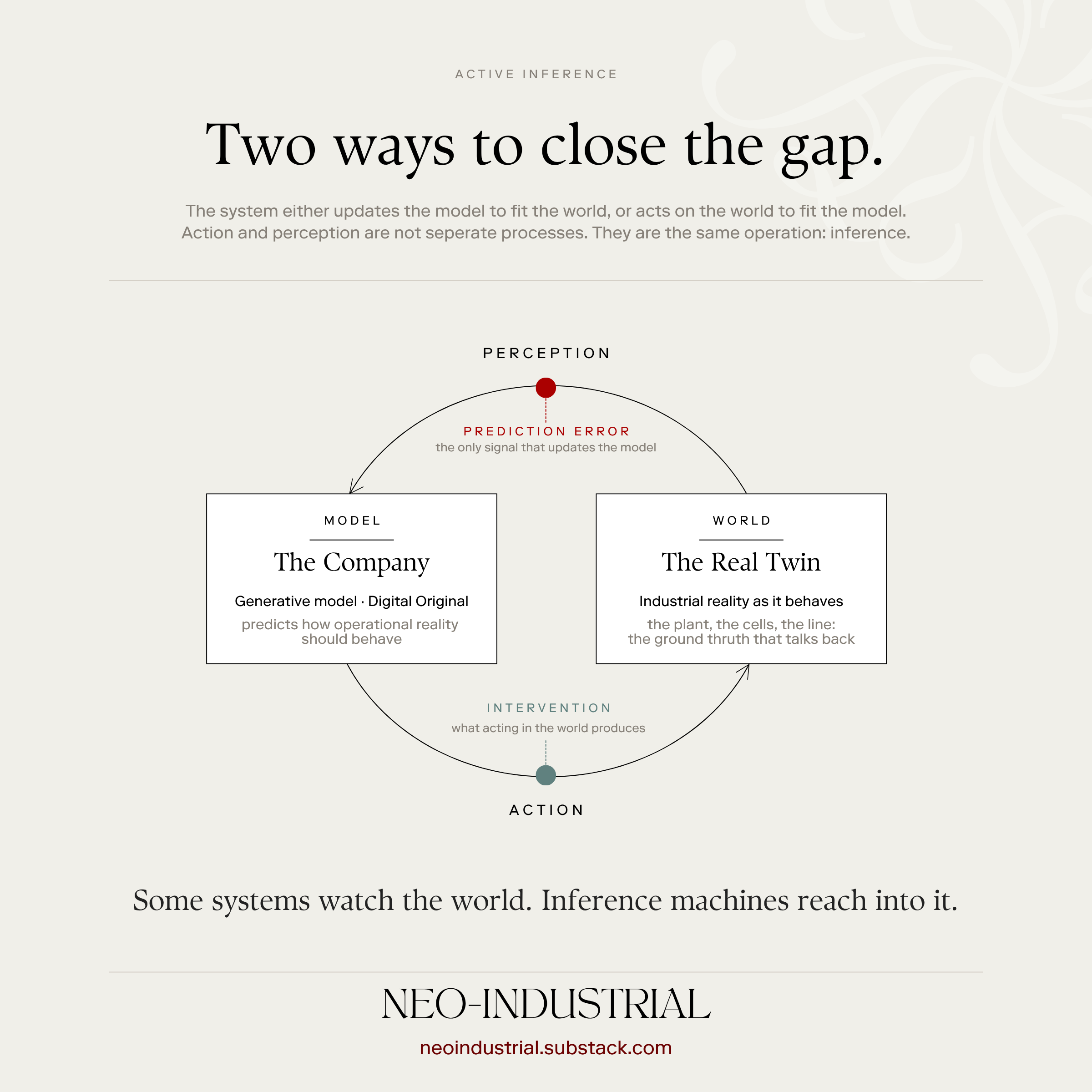
The distinction between these two ways of closing the gap is fundamental, and a contrast makes it concrete. A weather forecasting model is an extraordinary inference engine, but only in one direction. It updates its expectations against satellite data, and it gets better over time, but it does not change the weather. A bioreactor running a precision fermentation process at industrial scale is something else entirely. It predicts what should happen, but it also acts to achieve the predicted outcome, modulating feed rates, adjusting temperature, and intervening on the emergent dynamics. It closes the loop between model and world by reaching into the world1.
The Neo-Industrial Company is the organizational form of that second kind of system. It is not a lab that observes industrial reality. It is an inference machine that produces it.
The DBTL Cycle Is the Inference Loop
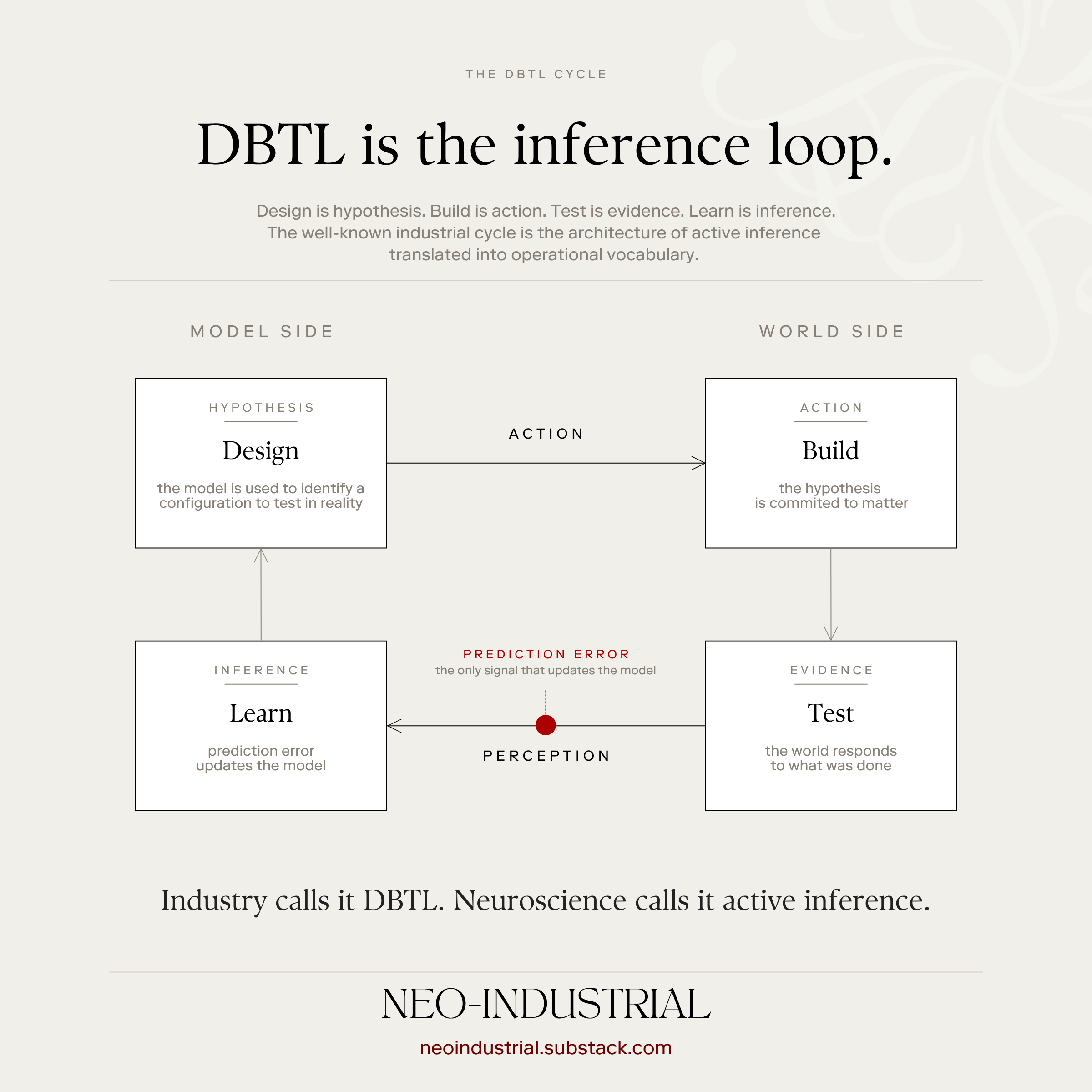
The Design-Build-Test-Learn cycle is, almost line for line, active inference translated into industrial vocabulary: hypothesis, action, evidence, update. The mapping explains why incumbents and the deep tech generation fail in distinct, structurally specific ways.
The Design-Build-Test-Learn cycle has been the conceptual backbone of every essay in this series. It is also, almost line-for-line, the active inference loop translated into industrial vocabulary, and seeing the correspondence is what makes the framework click.
Design is hypothesis formation. The organization, equipped with a generative model (the Digital Original), proposes a configuration of physical reality that should produce a desired outcome. Build is the action that commits the hypothesis to matter: a reactor is constructed, a strain is engineered, a process is set up. Test is the evidence-gathering step, the sensor data, the yields, the analytical readings, the world responding to what was done to it. Learn is the inference itself. The gap between what the model predicted and what the world produced becomes prediction error, and the organization either updates the model, adjusts the next action, or, more usually, both.
What makes this mapping more than a clever analogy is what it explains. The incumbent’s DBTL cycle, as argued in The Generative Phenotype, is not merely slow. It is epistemically constrained. When something unexpected happens on the line, the incumbent’s instinct is to treat it as a defect to be smoothed over, rather than as a clue about how its model of the process is wrong. In active inference terms, this is a system that has decided, structurally, to ignore its own surprise, its “out-of-distribution samples”. The active inference framework describes this pattern directly. A system that suppresses prediction error trades short-term stability for the capacity to learn over time. It hardens its world model against the world. The world catches up with it eventually.
This might seem like fairly dense theory, but the most concrete validation of the active inference framework we have come across recently comes from the industrial world, and from outside neuroscience entirely. In Many Small Steps for Robot, One Giant Leap for Mankind, Packy McCormick and Evan Beard of Standard Bots argue, with operational data and against the prevailing venture orthodoxy, that progress in robotics will not come from a single architectural breakthrough that suddenly makes general physical intelligence appear. It will come, in their words, from “climbing the gradient of variability”, one deployment at a time. The reason is that robotics is not bottlenecked on architectures. The architectures, world models, vision-language-action models, and transformer-based imitation learning largely exist. Robotics is bottlenecked on data, and not just any data. It needs data generated by your specific robot, doing your specific task, in your specific environment, with the actual forces and torques and contact dynamics that video and simulation cannot capture. The data, in other words, prevents your environment from being out-of-distribution for the robot’s underlying models.
The industrial implication is precisely the active inference one. You cannot reach a useful inference loop by perception alone, no matter how large your model or how clever your simulator. You have to act in the world. The most valuable signal is not the data that confirms what your model already predicted. It is the intervention data at the moment of failure, the prediction error that the lab could not have generated. Standard Bots' commercial logic, getting paid to deploy real arms in real factories, learning from where they fail, folding that learning back into the next deployment, is the active inference loop made into a business model.
“The most valuable signal is not the data that confirms what your model already predicted. It is the intervention data at the moment of failure, the prediction error that the lab could not have generated.”
The same architecture, in a completely different domain, is the case Packy McCormick and Pratap Ranade make for Arena Physica in Electromagnetism Secretly Runs the World (Yes, in case you didn’t notice, Massimo is a big fan of McCormick’s work, and McCormick has been a major source of inspiration for him). Arena Physica has built a foundation model for electromagnetic physics, a Large Field Model that learns the relationship between geometries and the electromagnetic fields they produce. The model becomes the generative substrate. A generator proposes candidate shapes, an evaluator scores them in milliseconds rather than the hours a traditional Maxwell solver requires, the best candidates are then fabricated as silicon, and the real-world measurements feed back into training. The system runs the loop “generate, evaluate, learn, repeat”. That is the active inference loop, named almost identically by people who arrived at it from electromagnetic engineering rather than from theoretical neuroscience. The convergence across robotics, electromagnetic design, and biology (Arsenale) is the strongest possible signal that the architecture is general. Inference machines are not a robotics phenomenon or a synthetic biology phenomenon. They are the form that any organization committed to industrial intelligence is being pulled toward.
Which means, by extension, that the Neo-Industrial Company’s DBTL cycle is fast active inference. The incumbent’s is degraded active inference. And the deep tech company that mastered discovery but failed at industrial transfer is the most specific failure of all: an inference machine whose internal world model worked beautifully under lab conditions, but did not transfer when the operating environment turned out to be different.