

*Translated with Claude – read the original article in Italian here
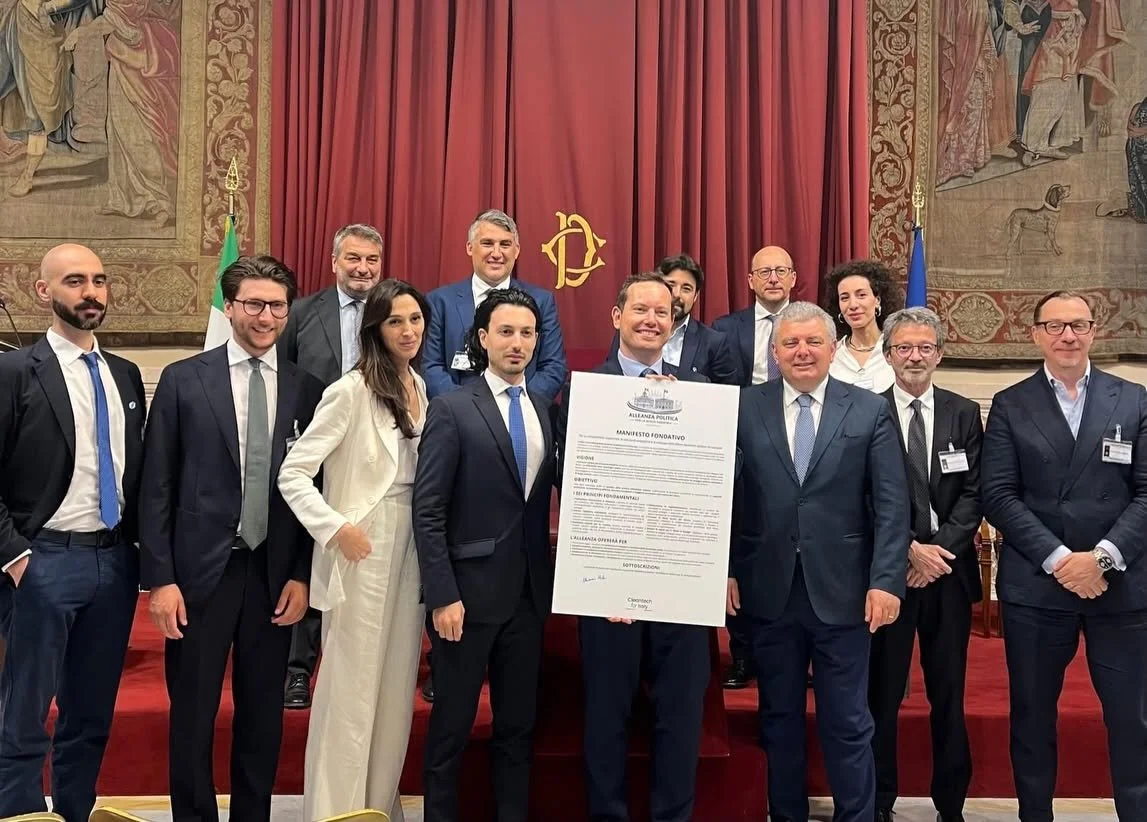
Startups and Parliamentarians at the Cleantech for Italy Summit 2026 ©La Repubblica
At the Cleantech for Italy Summit 2026, a cross-party working group comprising members of the Chamber of Deputies and the Senate was launched to transform Italian innovation into industrial capacity. The goal: to unlock 400 million euros in investments to industrialise the clean technology sector
There is a paradox that has weighed on Italy for years: the country produces world-class cleantech innovation, trains outstanding researchers, and generates startups capable of attracting international capital, and yet it watches as that same innovation is industrialised in Germany, France, or Asia.
It was to break this pattern that, on 18 June 2026, at the symbolic seat of the Chamber of Deputies, the Political Alliance for New Industry was born: a cross-party parliamentary pact, uniting the majority and the opposition, the Chamber of Deputies and the Senate, built around a shared priority that rarely manages to overcome the barriers of political polarisation: making Italy a protagonist in the new industrial supply chains of clean technologies.
Clean Technologies: Italy Innovates, but Does Not Industrialise
From 2019 to the present, the Italian cleantech sector has attracted 1.4 billion euros in investment. Substantial for an ecosystem still considered emerging. Venture capital and dedicated public institutions, such as CDP Venture Capital, are playing an increasingly important role. Too often, however, the country fails to transform this innovation into industrial capacity, globally competitive supply chains, and quality employment at home.
According to data presented by Cleantech for Italy, the estimated capital requirement for the sector’s first industrial plants is approximately 420 million euros: a figure that calls for a combination of public funding and private capital, co-investment instruments, and an industrial policy vision that, in Italy today, is still struggling to take on a coherent form. The result of this shortfall is tangible and measurable: technologies developed in Italian laboratories that are scaled up elsewhere, plants built outside Italy’s borders, and expertise that migrates abroad. This is a cost that does not appear in public budgets but is paid for in terms of lost skilled jobs, missed opportunities for industrial supply chains, and growing dependence on foreign countries in strategic sectors of the energy transition. The Political Alliance for New Industry is the institutional response to this gap.
The clean energy pact that transcends political boundaries
The Alliance was presented during the Cleantech for Italy Summit 2026, the annual event that brings together Parliament, institutions, investors, and innovators to discuss how to transform Italian technological excellence into new industry. The event opened with a speech by Adolfo Urso, Minister for Enterprise and Made in Italy.
Among the first signatories are Senator Silvia Fregolent (Italia Viva), MP Massimo Milani (Fratelli d’Italia), MPs Chiara Braga and Vinicio Peluffo (Partito Democratico), and Senator Stefano Patuanelli (Movimento 5 Stelle): a composition that cuts across all the main political alignments and represents the defining feature of the initiative.
“The Alliance was born to accompany the growth of Italy’s clean technology supply chains through a stable and concrete parliamentary commitment,” said MP Chiara Braga (Partito Democratico). “We need to create the conditions so that innovations developed in Italian universities, research centres, and companies can reach the market, grow, and establish themselves at a European scale. Faster procedures, adequate capital, and greater integration between research, companies, and investors will be among the Alliance’s core priorities.”
The founding document, the Manifesto of the Political Alliance for New Industry, outlines a six-point vision: supporting demonstration facilities and the first factories, mobilising private capital, accelerating permitting, creating market demand for innovative technologies, developing the necessary skills, and promoting European production within the framework of the Clean Industrial Deal.
The European Context: An Opportunity Not to Be Wasted
This initiative comes at a moment that is far from coincidental. Europe has just defined its Clean Industrial Deal, and the challenge now lies in its implementation: which countries will be able to translate the new European regulatory framework into real investment, new manufacturing capacity, and quality employment? China, the United States, and other major economies are mobilising substantial public resources to support their industries in the energy transition sectors. Europe is responding with the Clean Industrial Deal, but the match is won at the national level, through the ability of individual member states to transform European opportunities into concrete instruments.
For Italy, the context is challenging: high energy costs, weak investment, and growing competitive pressure. But it also has a solid manufacturing base and widespread expertise that could make a real difference, if adequately supported. “Italy has a manufacturing base, technological expertise, and companies capable of playing a central role in the new cleantech supply chains. Strengthening this industrial capacity means supporting the country’s competitiveness, energy security, and strategic autonomy,” said MP Massimo Milani (Fratelli d’Italia).
Italian Cleantech Startups
At the Summit, alongside members of Parliament, four innovators took the floor who embody the challenge of cleantech industrialisation in Italy, representing examples of technologies and supply chains that the Alliance intends to support as they transition to industrial scale. Alessandra Accogli, Co-Founder & CEO of Sinergy Flow (speaker at the Green & Blue 2026 Festival), works in the energy storage sector; Marco Bersani, Co-Founder & CEO of Circular Materials, operates in the field of the circular economy; Michele Bugliesi, Co-Founder & CEO of RARA Factory, is pushing the frontier of sustainable manufacturing; Massimo Portincaso, Co-Founder & CEO of Arsenale Bioyards, is working to reimagine industrial production in a nature-aligned direction. Different stories, different technologies, but a common obstacle: finding in Italy the conditions, financial, regulatory, and institutional, to build the first plant at industrial scale.
The Proposals: From the Lab to the Factory
At the Summit, Cleantech for Italy presented eight concrete proposals to accelerate the sector’s industrialisation, structured around three key levers. The first concerns public finance: new co-investment instruments and public guarantees to attract private capital during the riskiest phases of industrial development. The second focuses on demand creation, through innovation-oriented public procurement and purchasing criteria that prioritise European production and emerging technologies. The third addresses the simplification of permitting processes, with the aim of reducing the time and procedures required to build demonstration plants and the first factories.
“With the launch of the Political Alliance for New Industry, we are taking a decisive step towards the conditions needed to transform Italian innovation into industrial capacity,” Federico Cuppoloni, Director of Cleantech for Italy, told Green&Blue. “After years of growing investment in the early stages of technological development, Italy now has a core group of innovative companies ready to scale up to industrial levels and compete in global markets. What is needed now is a broader debate and the instruments capable of supporting Italian cleantech through the phase that will determine its competitive weight: industrialisation.”
The Alliance’s real bet is not political, but structural: building a permanent parliamentary presence on an issue that requires years of consistent work, regardless of changes in government. An unprecedented challenge for a political system accustomed to thinking in legislative terms, in a sector that thinks in decades.