


Biological AI will not be trained on found data. It will be built by whoever makes the data, in steel.
Foreword
I love abstractions, because they are the means to deep understanding and also are a key tool to deal with complexity. But they intrinsically tend to make things less accessible and tangible, and I tend to indulge in them, which does not help with the former point…
Hence, after three pieces where I went higher and higher in the level of abstraction (Neo Industrial Age → Generative Phenotype → Inference Machines), I felt it was time to ground the thinking into a concrete case, and the best way to do it for me was to go back to what I am building, as this is actually the starting point of my abstraction journeys.
I had to make a choice, though. Either write a didactic piece centered on the concepts of the three previous pieces to explain each of them, or write a piece focused on Biological AI and what it means, and while doing so hint to the concepts, but without hijacking the narrative.
I decided on the latter, also because Biological AI is the most “extreme” embodiment of the Neo-Industrial Age, as it turns living systems into programmable manufacturing systems. The price for that is that I will have, at times, to go deep into some technical aspects. I hope you’ll nevertheless come along.
So, as you go through the piece, even the technical parts, read it thinking that you are reading about the Neo-Industrial age, the Generative Phenotype and the Inference Machines and that Biological AI is one of their embodiments. Where appropriate, I will refer to those concepts, but not always, as I will trust your capability to make the connection in order to protect the flow of the piece.
Onto the essay now.
"You get over that scale-up hump eventually. In most projects, you achieve at large scale what you achieved at small scale. The challenge is that it is still not economically viable."
The sentence was said to me during the summer by the corporate R&D lead of one of the large industrial biotech companies, and it has stayed with me since. Actually not because it was new (everyone who has spent time in industrial biotechnology is somehow aware of this), rather because of how casually it was said, as a fact of life, the way one talks about the weather. Somehow, that sentence compresses forty years of industry history into three lines: the biology works, the process can mostly be scaled, but the resulting process cannot be operated at a price anyone is prepared to pay.
This essay is about why that has been true, why it has just stopped being a law of nature, and what has to exist for it to stop being true in practice.
“The problem is not necessarily biology. It is much more the cost of finding out how biology behaves under industrial conditions.”
The short version, which I will spend the rest of this essay arguing for, is the following: the problem is not necessarily biology. It is much more the cost of finding out how biology behaves under industrial conditions. That cost is set by intelligence and by data.
Intelligence is the enabler. Data is the moat. Everything else, as I will try to show, follows from these two.
Not only for Biological AI, but rather for all Neo-Industrial companies.
For once, a graveyard is good news
On August 9th, 2023, Amyris filed for Chapter 11. I wrote about that moment at the time, in “Industrial Romanticism“, as the end of an era rather than the end of an industry. It was not the first and not the last of such industrial biotech failures, so that the cemetery of all the corporate dead bodies of that era has been even dubbed the industrial biotech graveyard. While this could sound like the ultimate judgment on the industry, it is actually good news. Let me unpack this.
I have written about this before: Amyris built real fermentation infrastructure, peaked at $342 million of revenue in 2021, carried about $1.3 billion of liabilities into Chapter 11, and pivoted from biofuels to cosmetics to consumer brands before it ran out of road. Zymergen raised well over a billion dollars, listed at roughly $3 billion, and fifteen months later sold itself to Ginkgo for about a tenth of that. Ginkgo, which promised to be the AWS of biology, has given back the overwhelming majority of its peak value. Evolva did strain, process, and downstream concurrently, brought terpenes to market, and still could not beat naturals or petrochemicals on cost, and it was eventually sold to Lallemand1.
The instinct is to read this as a verdict on the science, and in my view it is the wrong reading: in many of the prominent cases, the underlying biology worked, and the molecules could be made. What did not survive the encounter with the plant was the economics, and it failed at a predictable place, somewhere between the lab bench and the plant, where laboratory performance meets industrial reality. (And note that the direction of travel makes this worse, not better: the more intensive the fermentation, the higher the oxygen-transfer rate the industry needs to bring costs down, the more heterogeneity is amplified at scale, and the harder scale-up itself becomes.)
This is why, ultimately, the graveyard is good news. A sector that failed on science is a sector to avoid. A sector that failed on an economic constraint, one that has just changed (as we will see), is a sector to enter.
“A sector that failed on science is a sector to avoid. A sector that failed on an economic constraint is a sector to enter.”
Two inheritances and a problematic relay
But to understand things, we need first to take a step back. In fact, industrial biotechnology has never had its own economic logic. It borrowed one – twice.
Both were wrong.
First, from petrochemicals, it inherited the belief that bigger is better. The first wave was born in the biofuels boom, competing against oil, and it imported oil’s core assumption: unit cost falls with scale, so the answer to any economic problem is a larger vessel. In many chemical processes, where the reaction is comparatively deterministic and scale can often be translated into predictable process economics, that assumption holds. In a fermenter, where the reaction is a living population that experiences gradients, drifts genetically and behaves differently at 50 m³ than at 5 L, it is close to false. Scale in biology buys less than scale in chemistry and costs more, because every additional cubic metre adds mixing heterogeneity, oxygen-transfer limitation and contamination risk. A generation of companies built cathedrals and discovered that the congregation had changed.
Then, from biopharma, it inherited a “relative indifference” to cost. And the use of quotation marks is very deliberate, because it is not that pharma does not care about cost; it is that pharma comes from a world where a gram is worth thousands of dollars, and the binding constraint is regulatory. This brought with it a way of working (stainless-steel batch orthodoxy, a fed-batch default nobody questioned, cost of goods as a downstream concern) that minimised risk without ever questioning the underlying assumptions. That cost base cannot serve a market that clears at ten euros a kilogram. It cannot actually even serve one that clears at a hundred.
The first two inheritances are about where the industry’s economics came from. The third is different in kind, because it is not about economics at all. It is foundational and about how the work is organised. This is the one I care most about, because it is the one that intelligence can actually change.
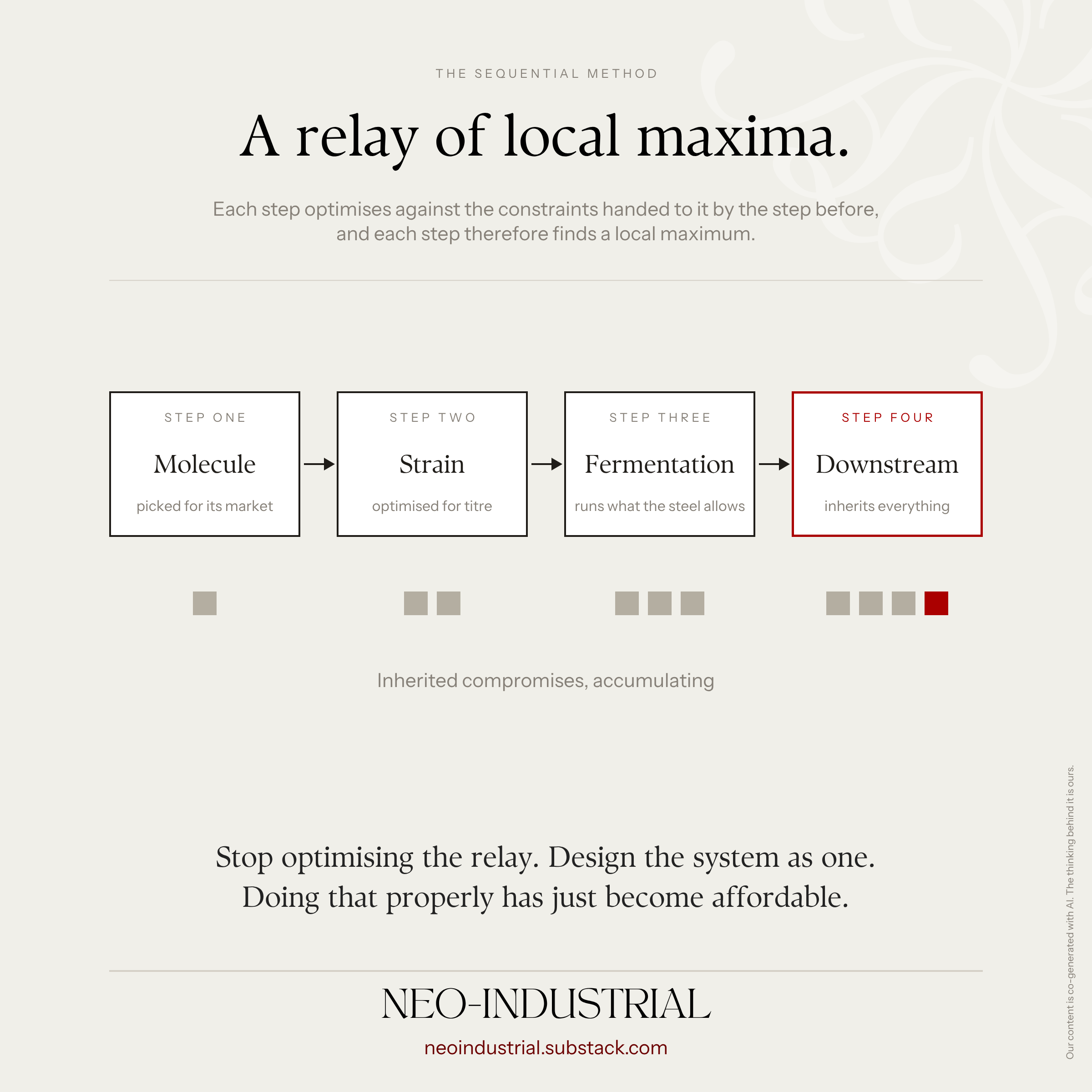
It is a quieter, yet structural, defect: a sequential method. Pick the molecule. Engineer the strain for titre. Hand it to fermentation, which inherits the strain and runs it in fed-batch because that is what the equipment was bought for and what the last project used. Hand the broth to downstream, which inherits its viscosity, its impurity profile, and whatever by-products nobody screened for. Each step optimises against the constraints handed to it by the step before, and each step therefore finds a local maximum. Chain four local maxima together and what you get is not an optimum of any kind, rather an accumulation of other people’s compromises, and the last team in the relay, the one carrying the largest share of the cost, inherits every one of them.
“Chain four local maxima together and what you get is not an optimum of any kind, rather an accumulation of other people’s compromises.”
The consequences of this structural defect are very different from those of the borrowed economics. The borrowed economics can (and should) be un-borrowed, and new (proper) economics will eventually fall in place. But the relay is structural; it is a method, and a method is only ever replaced by another method. The other method, in this case, is nothing new: “start with the end in mind”, i.e., from the price the market will pay, work backwards through what that price allows the process to cost, through the recovery train, through the fermentation, to determining the genetic traits the selected host must have, and settle all of it at once, as one system, rather than four consecutive steps. I suppose that almost everyone in the industry is aware this is the right way to do it. Yet, very few do it, and the reason is cost and capability, not lack of awareness: designing four coupled steps together means exploring a huge combinatorial space, which until very recently meant an incredible amount of cognitive resources (i.e., intelligence) and a great deal of physical experimentation. “Starting-with-the-end-in-mind” was simply too expensive to do properly. That cost is what has just collapsed, and it is what the rest of this essay is about.
The layer where the buck stops
The development of the science of biology over the last twenty-five years is remarkably clean.
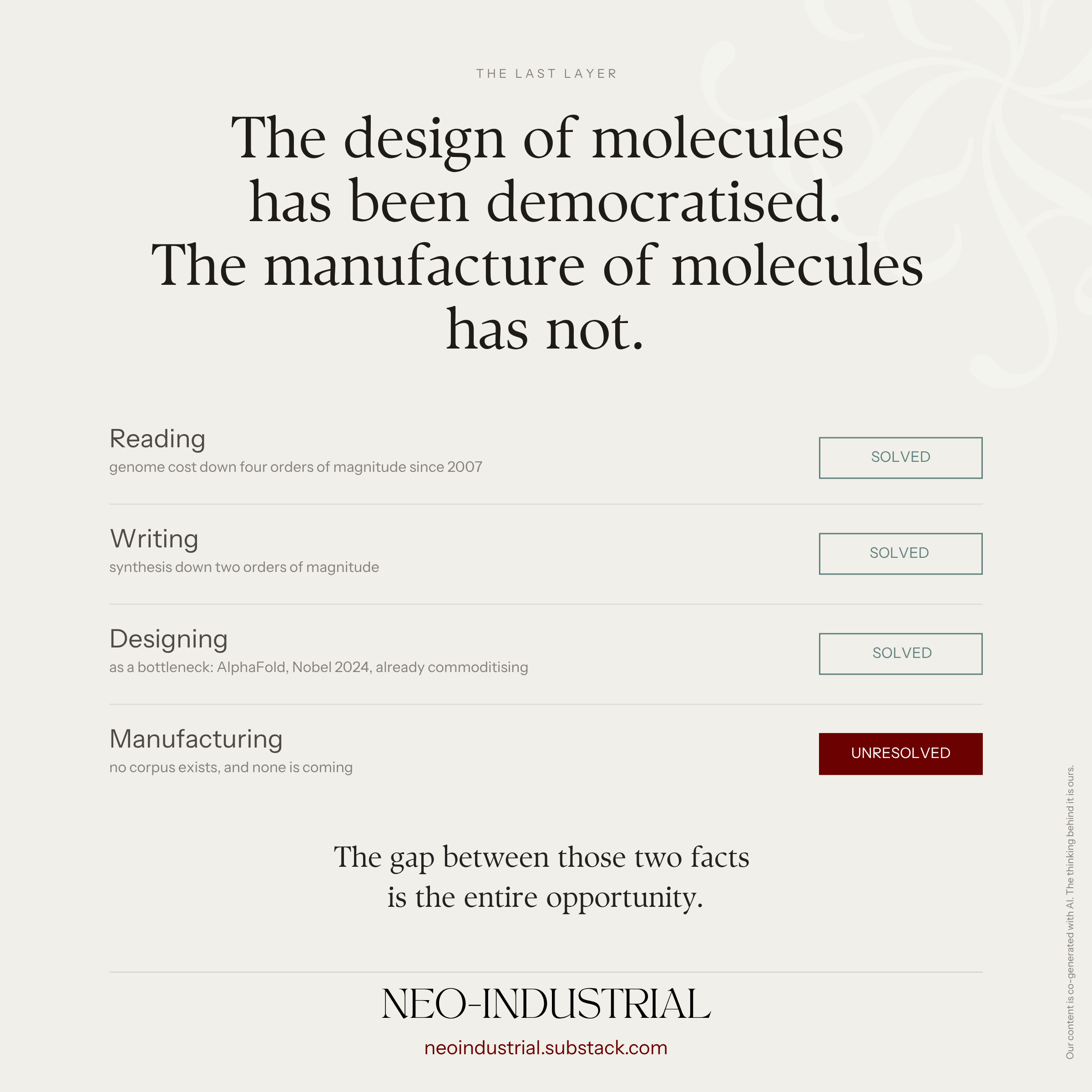
Reading was the bottleneck. Then it wasn’t: the cost of sequencing a human genome has fallen by more than four orders of magnitude since 20072. Writing was the bottleneck. Then it wasn’t: synthesis costs have fallen by more than two orders of magnitude, and China’s tooling build-out (GenScript, Tsingke, Sangon, BGI) has pushed the global floor lower still. The physical construction of a strain is now a purchase order. Designing a good one is still damn hard, and I do not want to be misread on this: design has not stopped mattering; it has stopped being the bottleneck, because the tools to produce one are now bought rather than built. So the bottleneck kept moving; now, after reading and writing, designing the molecule was the bottleneck. Till it wasn’t: AlphaFold and the generative protein-design stack built on top of it collapsed a problem that had resisted the field for fifty years, and the 2024 Nobel Prize in Chemistry was the formal acknowledgement that the layer is, for practical purposes, largely solved3.
Each of these was, in its moment, the thing everyone believed was the hard part. Each one fell. And each time it fell, the constraint did not disappear; rather it moved, in one direction only, downhill, toward matter, till it arrived at the last layer, where it has now stopped. We can read biology, write biology, and design molecules we could not have imagined a decade ago. We cannot predict what any of them will do inside an industrial process, and therefore we cannot make most of them at a cost anyone will pay.
The design of molecules has been democratised. The manufacture of molecules has not. The gap between those two facts is, in my view, the entire opportunity.4
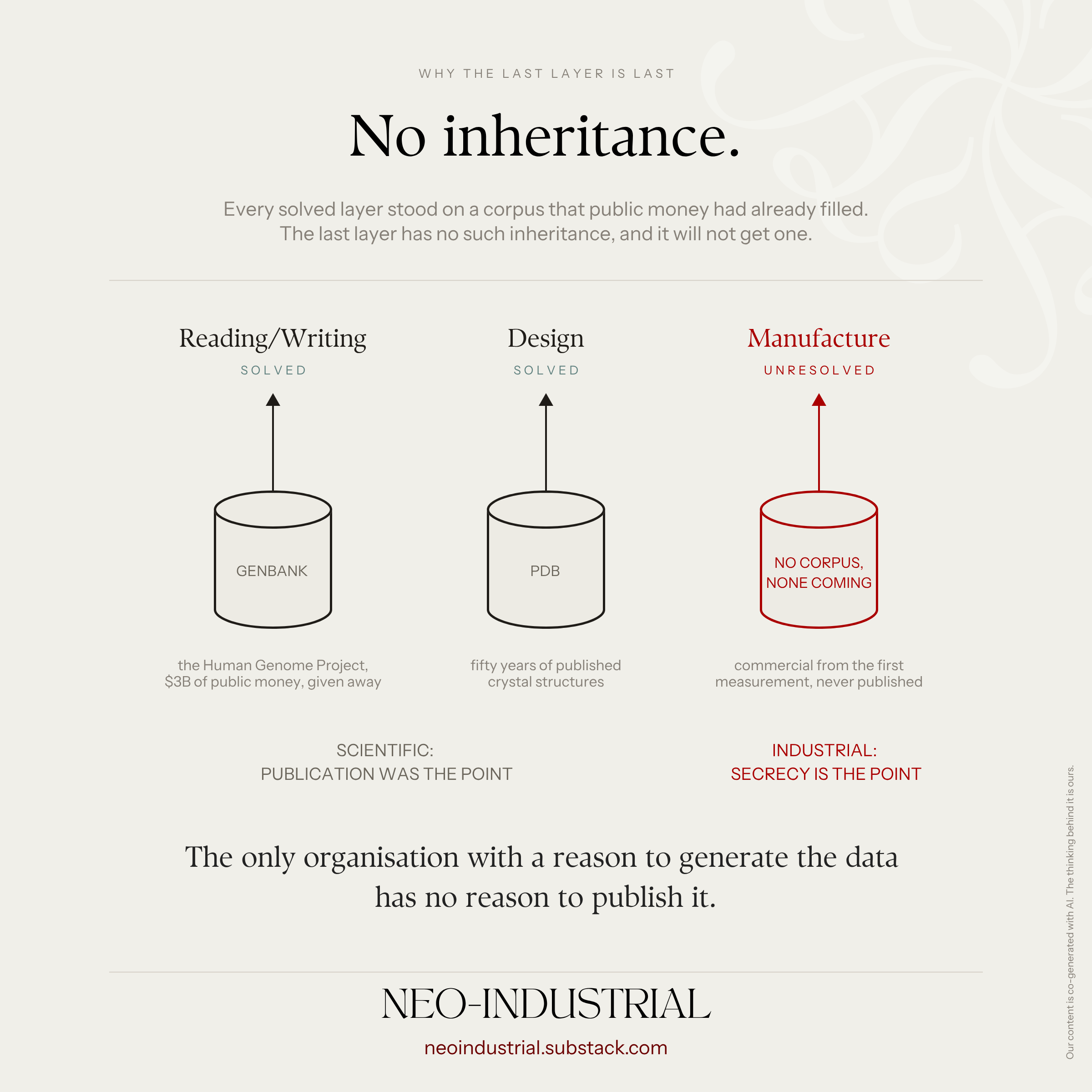
A core point here is that the previous layers were not solved by existing datasets. They were solved by expensive physical endeavours. The Human Genome Project cost three billion dollars, and its output was public by choice rather than by nature: at Bermuda in 1996 its funders committed to release every sequence within twenty-four hours of reading it, a choice that held when Celera tried to sequence the genome privately, and that was available at all because the endeavour was scientific and the value of the data lay in its being shared. Or take the design of molecules and the Protein Data Bank (PDB), with fifty years of published crystal structures. AlphaFold did not derive protein folding from first principles; it learned it from a PDB that public money had already filled, because the work was scientific and publication was the point. Each layer was solved with the residue of the one before, and the residue was public.
The last layer, the manufacturing of these molecules, has no such inheritance, and, in my view, it will not get one. What it requires is a different kind of corpus, an industrial one rather than a scientific one: how a living population behaves under the conditions of a plant, and what that behaviour does to the cost of getting the product out of the broth. There is, to my knowledge, no repository anywhere of what this organism does when oxygen transfer is limited at 200 mmol/L·h, what that does to the viscosity of the broth, and what that does to the cost of the recovery train. The reason is structural, not budgetary5. A process only ever reaches industrial scale because somebody expects to make money from it; the runs that would fill the corpus are therefore the runs of a commercial operation; and a commercial operation has every reason to keep them, because they ARE the operation. Public money has built pilot plants and will build more, rightly so, but a pilot plant is steel, and the data generated in it belongs to whoever rents it and leaves with them. The scientific layers were solved on a commons that public policy chose to create. This layer will be solved by whoever generates the data and, for the same reason, keeps it.
The direct consequence runs against what I suspect a good part of the sector is quietly waiting for: there is not going to be an AlphaFold moment for biomanufacturing.
“There will be no AlphaFold moment for biomanufacturing. Whoever wants the model will have to make the data first.”
AlphaFold was possible because fifty years of crystal structures were sitting in the PDB, waiting to be learned from. Nothing comparable is sitting anywhere for bioprocesses, and nothing comparable will be assembled by a public programme. Whoever wants the model will have to make the data first.
What Biological AI is, and what it actually does
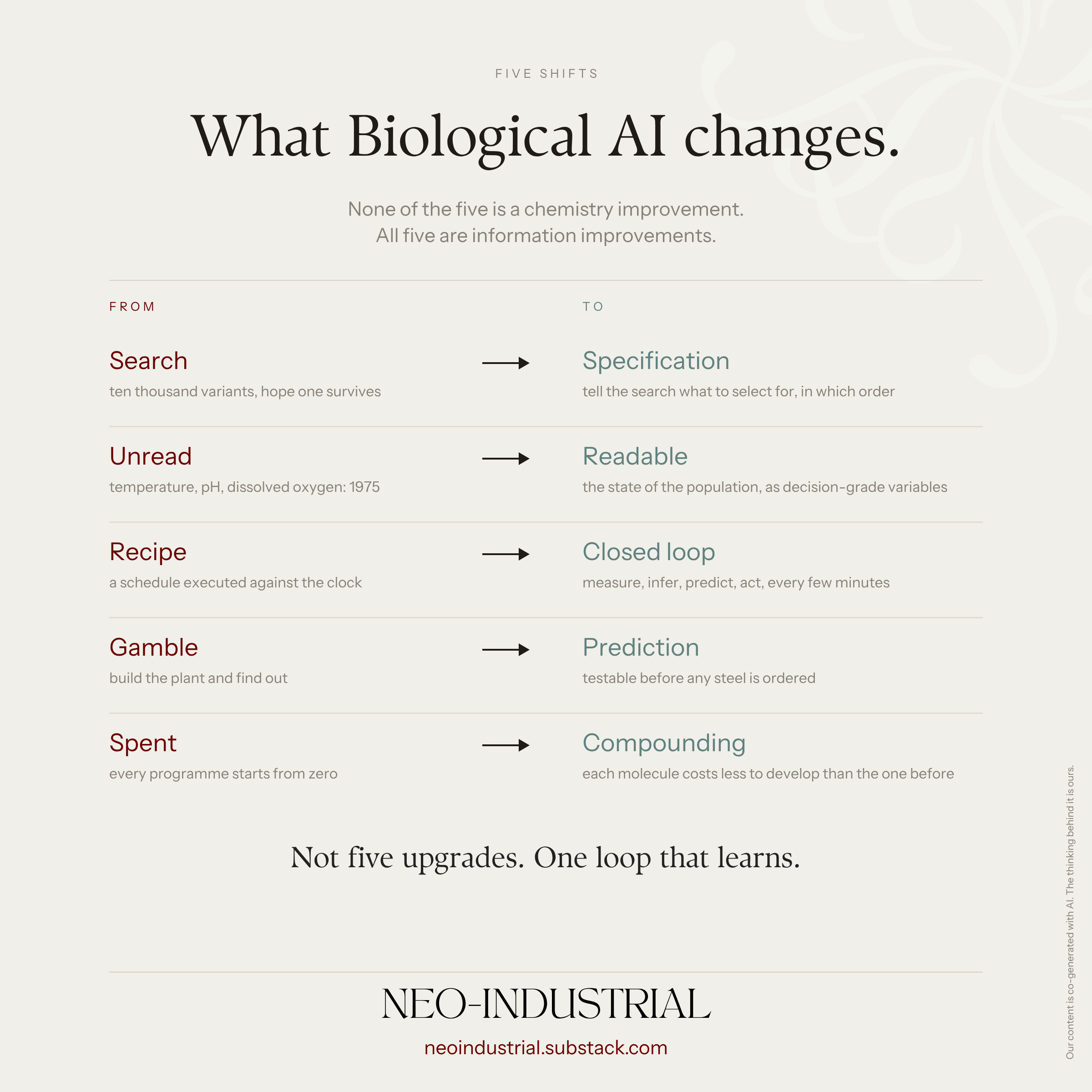
I have taken to calling the intelligence that solves this last layer “Biological AI”, and to defining it as the intelligence needed to build, operate, and continuously update a model of biology and to speak its language under industrial conditions. Admittedly, it sounds like a scientific aspiration, and aspirations get discounted, at best, so let me state the same claim operationally. Five things have become possible in the last three years that were not possible before. None of them is, strictly speaking, a chemistry improvement. All five are information improvements.
1. Stop searching, start specifying.
We do not understand biology well enough to specify what we want, so we search for it: directed evolution, high-throughput screening, combinatorial libraries. Ten thousand variants screened for titre, and the winner sent to a vessel it has never seen. Magnificent technologies, and, if we are honest with ourselves, a way of compensating for what we cannot predict. The trouble is not that search is slow, rather that it selects for the wrong thing. A large part of what a process costs is decided not by the molecule alone, but by the system, i.e. molecule, organism, broth and operating conditions interacting. Whether the product ends up inside the cell or outside it depends on the host. Stability depends on the broth. The concentration at which a product poisons its own producer can differ tenfold between two hosts making the same molecule. A screen for titre sees very little of this. An intelligence that has learned from enough real processes can do what the screen cannot: enumerate the plausible routes, eliminate in silico everything that thermodynamics, separation limits or regulation already rule out, and hand the search a specification, i.e. what to select for and in which order (low mannan load, reversible flocculation at harvest pH, product tolerance at low pH, and only then titre). The intelligence does not replace the search. It tells the search what to look for, at the system level, with purification being the determining factor. Everyone in the industry can improve titre. Few can tell you precisely what else to ask for.
2. The fermenter becomes readable.
Biology is not silent, it is simply not being read. A fermenter continuously generates information (off-gas composition, torque, dielectric response, optical and vibrational spectra, the drift of a mass balance that no longer closes), and the industry has always recorded the three things that were easy to instrument in 1975, temperature, pH and dissolved oxygen, and left the state of the population to the operator’s intuition: the batch “feels off”. Intelligence now converts those signals into inferred state, i.e. metabolic condition, stress, viability, where the product is, how processable the broth will be and therefore what the downstream train will cost. This is what translating the language of biology means in practice, and there is nothing poetic about it. Many of the sensors are not new, so a fair question is why now. Three things changed together: some sensors became cheap and robust enough to live on a production vessel rather than in a lab; most importantly, models can now infer metabolic state from complex fermentation data in ways a human operator could not. And a signal nobody can read is a signal nobody collects; and once you can act on a variable, one you could not see becomes one you cannot afford not to see. Intelligence is the enabler because it turns signals that were “noise” into variables with a price. Data is the moat because that signal has to be captured on real vessels, under real conditions, and nobody has been capturing it.
3. From recipe to closed loop.
Industrial fermentation is still run as a recipe, a schedule written in advance and executed against the clock, on the assumption that this batch resembles the last one. Living populations do not honour that assumption: a lag phase that starts two hours late, a feed that runs slightly rich, and the recipe is already wrong, and nobody knows until the batch is over. A model that reads the state of the population (point 2) and predicts what it is about to do converts operation into a closed loop: measure, infer, predict the next few hours, choose the action that keeps the run on the trajectory the design intended, and repeat, every few minutes, for the length of the batch. Every industry that matured made this transition, from craft to process control, and for the same reason: control converts variance into yield, because a process you can hold on trajectory needs less margin, less over-design, less waste. Fermentation is one of the last significant industrial processes still waiting for it, and it has waited precisely because the variable that matters most, the state of the population, was the one nobody could see. You cannot control what you cannot observe.
4. Scale-up stops being a gamble.
The most expensive question in the field, will this behave at 50+ m³, has never had a first-principles answer, so it has been answered by building the thing and finding out. It can now be posed as a comparison between two measurable quantities. A cell circulating in a large tank does not experience a steady environment, rather a rhythm of feast and famine, passing every few seconds through zones rich and poor in sugar and oxygen, and the tempo of that rhythm is set by the geometry and mixing of the tank, which can be calculated before the tank is built. A strain’s ability to withstand it can be measured at bench, by imposing swings of the same kind and recording how fast the organism recovers. In this context, scale transfer can be reframed as a measurable comparison between the disturbance imposed by the vessel and the organism’s ability to recover from it. This also ties the four points together: the right control policy depends on the vessel, the state worth observing depends on what that vessel does to the population, and the specification depends on both. The intelligence is not a model floating above the plant, rather one shaped by the geometry, the flow and the history of the steel it lives in. Call it Embodied Intelligence; I will come back to it below as a condition, not a feature. To be sure, the scale-up criterion is not proven, yet. It is one of the propositions Arsenale intends to falsify early, but it illustrates the category of questions that becomes answerable when biology is instrumented and modelled rather than merely observed.
5. Every molecule teaches the next one.
Today everything learned in a development programme is spent on that programme and lost: how a host behaves under oxygen limitation, how a particular broth foams, how a soft sensor was calibrated, all of it lives in the heads of the team and in a report nobody will reopen, and the next molecule starts from zero. This is why the sector has been, structurally, a services business, selling its learning once. Once that knowledge is captured (point 2) and structured by host, by mode and by unit operation, as calibration libraries and production archetypes, it becomes reusable across molecules, and each molecule then costs less to develop than the one before. That is a curve the sector has never had: economies of learning rather than economies of scale, as I argued in “The Neo-Industrial Age“, where the rate of learning, not the size of the vessel, sets the cost. It is the difference between a services business and a compounding one, and, I believe, the axis on which a good part of the sector’s value will eventually be decided.
Now the economic consequence, and this is a very important passage. Thermodynamics sets the floor of what a bioprocess can cost. Feedstock and energy are real, and no amount of intelligence repeals the oxygen-transfer and heat-removal ceilings. But almost no industrial bioprocess operates anywhere near that floor, and the distance between the floor and where processes actually run has, so far, been set much less by physics than by lack of understanding, and understanding, i.e., intelligence, is the one input whose price has just collapsed.
Intelligence is the enabler.
The prize is the vast middle
This is the part that I think the sector has consistently mis-sold, and it is where the economics become tangible.
Every company in the graveyard promised to take cost out of a molecule. That is a margin story, and, over time, sophisticated investors have learned to discount it, because it has been told and broken repeatedly. The real prize has a different shape.
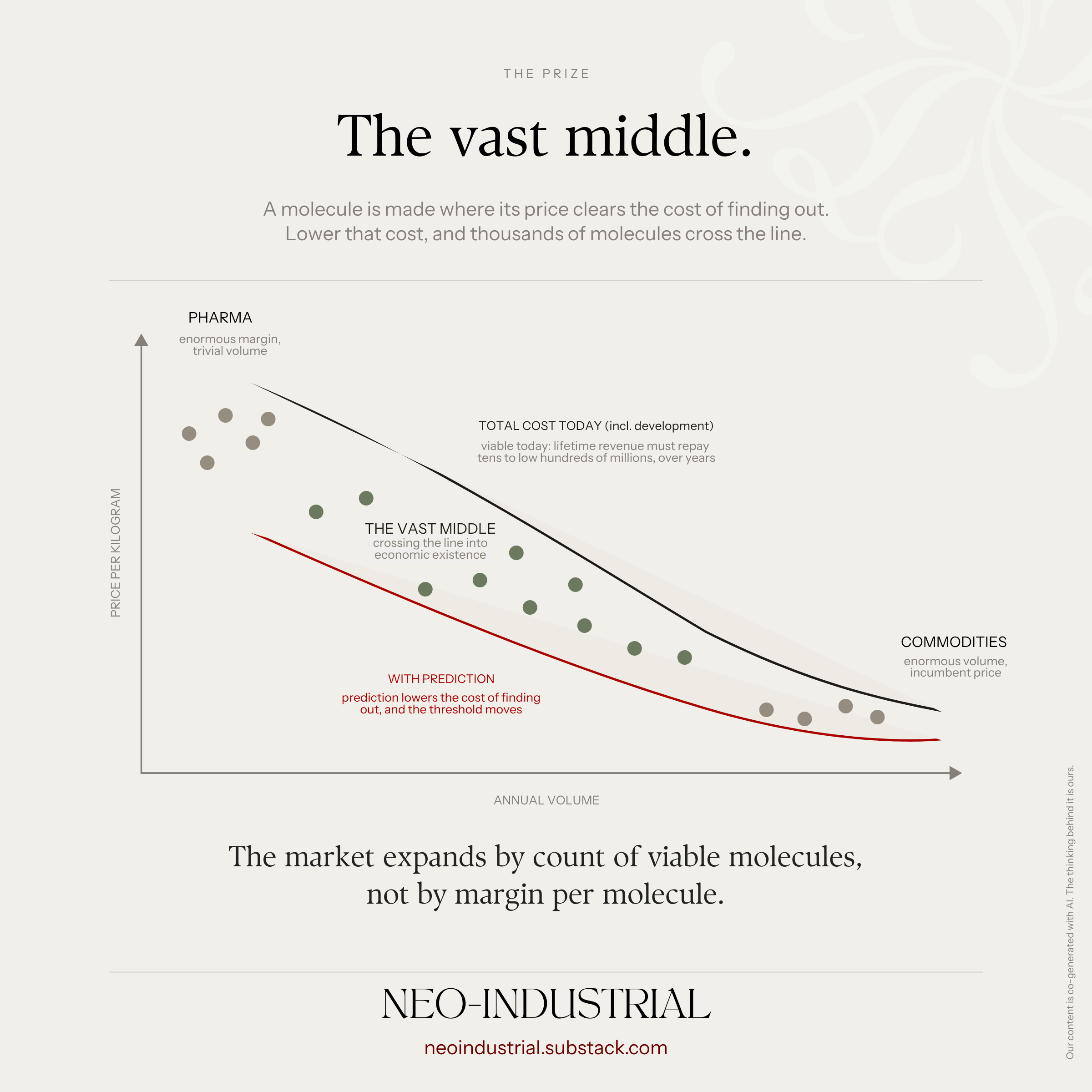
Developing a commercial bioprocess costs, on any honest accounting, somewhere in the tens up to low hundreds of millions of dollars and can take up to five, even ten years. That is a fixed cost of admission, and it has to be amortised over the lifetime volume of a single molecule. The arithmetic that follows is brutal, and it explains a good part of the industry’s history: only molecules with sufficiently large lifetime revenue can justify the attempt. Which is why industrial biotechnology has only ever been able to chase two categories. Commodities, where the volume is enormous but the price is set by a petrochemical incumbent with a century of accumulated process learning, and where Chinese overcapacity now sets the price anyway. Or pharmaceuticals, where the margin is enormous, and the volume is trivial. The first killed the first wave. The second is where the survivors of the second wave are retreating.
The vast middle has never been addressable. Thousands of molecules (specialty chemicals, performance ingredients, materials, agricultural inputs, cosmetic actives), each worth tens of millions a year, individually too small to justify a nine-figure programme, collectively an enormous market that biology has simply never served. Not because the biology is harder, but because the cost of finding out exceeds the prize.
There is a second, quieter version of the same barrier. Most of the natural small-molecule space can now be made by synthetic biology, because the biological routes have been elucidated. And yet, because these molecules have never been available, most materials scientists in an applications role do not know what to do with them. They can guess (”I think I need a small molecule with a constrained ring and two hydroxyls on opposite sides of a phenol”), but to test the guess they need a hundred grams of a few candidates, and those hundred grams do not exist until somebody pays half a million dollars or more for a strain, a fermentation, and a recovery process. The cost of finding out does not only block the making. It blocks the asking as well.
The moment you lower the fixed cost of process discovery, you are not only improving the margin on the molecules being made today; you are redefining which molecules are worth making at all. The number that should move is not necessarily only cost per kilogram but the minimum lifetime revenue at which a molecule justifies a process as well. Every reduction in that threshold pulls a new stratum of molecules across the line into economic existence. The market expands by count of viable products, not by margin per product.
“The vast middle has never been addressable. Not because the biology is harder, but because the cost of finding out exceeds the prize.”
And it is not anything new, by the way. This is the argument that built the fabless semiconductor industry, and made TSMC one of the ten most valuable companies in the world (sixth, as of late September 20266). Before the fab model, a chip had to justify a fabrication plant, so only chips with enormous volumes existed. Once the fixed cost of getting a design into silicon collapsed, the industry did not get better margins on the chips it was already making. It got two orders of magnitude more chips. The market was not captured. It was created. By TSMC.
This is what finally makes Nature Co-Design (the frame I worked on years ago with BCG and Hello Tomorrow, and the thread that runs through all of this writing) operational rather than aspirational. We can already design molecules and materials that nature makes and chemistry cannot. What has been missing is any economical way to produce them. Prediction closes that loop. Biology stops being a manufacturing method of last resort, chosen when chemistry fails, and becomes what I argued in “Industrial Romanticism” it should always have been: one of the most sophisticated design partners available, engaged on its own terms.
The data, the body and the steel
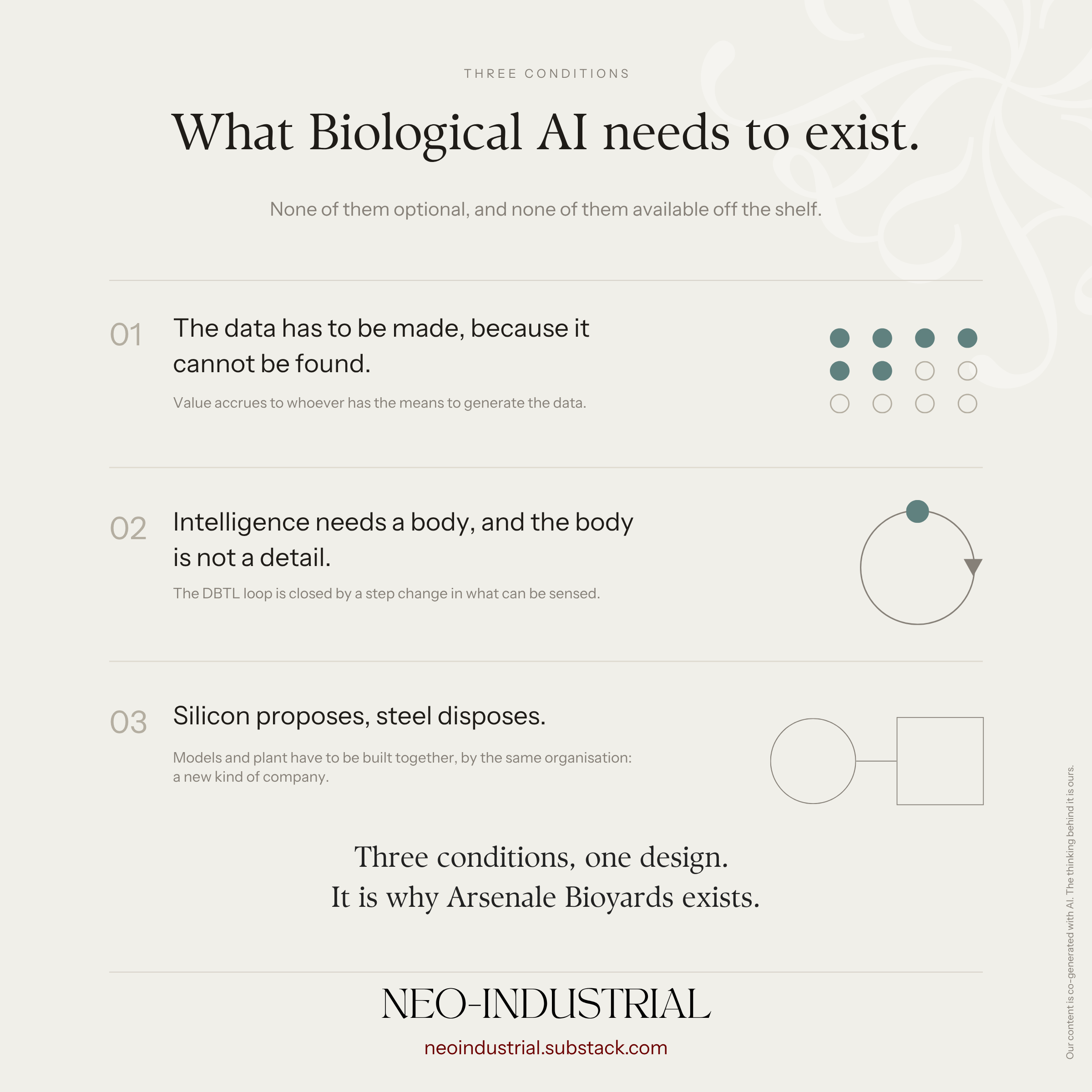
All five things that have become possible are capabilities of an intelligence. The question that decides who gets to build such an intelligence is what it needs in order to exist. In my view, there are three conditions, intrinsic to the field, not choices of a single company.
Condition 1. The data has to be made, because it cannot be found.
Language AI had a head start it never had to earn. The internet was not written in order to train anything, but it was there, and a model could begin from a corpus humanity had already produced for other reasons. Physical AI had no such corpus. Robotic manipulation data cannot be scraped; it has to be collected one interaction at a time, by whoever owns the robot. The moment the field understood this, the whole sector was repriced, because it changes who holds the advantage: whoever owns the apparatus that generates the data owns the flywheel This is what explains the valuations of Physical Intelligence, Figure and Skild7. Biology needs this argument more than robotics does, not less. A robot obeys Newton and Maxwell equations, and where the physics is known, simulation is a partial escape from the data problem. Biology, as I wrote with my co-founder Matteo in Neo-Industrial companies are inference machines, has no complete first-principles simulator and will not have one: cells adapt, populations drift, and the state of the system is only partially observable at the best of times. So the corpus has to be generated deliberately, by running biology under industrially relevant conditions and instrumenting it densely enough that each run yields decision-grade information rather than an anecdote. In this field the dataset is a capital asset, and value accrues to whoever has the means to generate it, not to whoever has the best model.
Data is the moat.
Condition 2. Intelligence needs a body, and the body is not a detail.
A brain in a jar predicts nothing, and I mean this quite literally. Models learn from measurements, and biology’s most economically important variables (metabolic state, product location, broth processability, the onset of a stress response) are precisely the ones a conventional plant does not measure. Train an intelligence on temperature, pH and dissolved oxygen and you get an intelligence that sees what 1975 saw. Perception therefore requires a nervous system: a sensing layer built into the vessel, not bolted on afterwards. Action requires muscles, and the muscles constrain what the mind may think: if your hardware can only run fed-batch, your design intelligence can only propose fed-batch, not because physics forbids anything else, but because the alternative is unbuildable and therefore untestable. Hardware does not only execute the hypothesis space, it defines it. Both need a backbone, modular and composable, with energy treated as a plant-level design decision rather than a utility bill, because feedstock and energy set the floor. And all of it requires a ladder of vessels spanning the relevant scales with the same instrumentation at every rung, because a measurement at one scale is worth little unless it can be checked against another. The loop everybody talks about (design, build, test, learn, with AI at one end and automation at the other) is therefore not closed by better models or faster robots. It is closed by a step change in what can be sensed. And, for anyone hoping to build this as software: without the full stack there is no Biological AI, not even a weaker version of it.
Condition 3. Silicon proposes, steel disposes.
In silico work is not optional and its value is enormous, as discussed in Generative Phenotype: iteration in the digital domain costs compute and hours instead of steel and months, and a company that iterates physically first is not competing at the same tempo as one that iterates digitally first. But a model is only valid over the conditions it was trained on, and conditions move. I described the pathology in “Inference Machines” (model drift, the Digital Original that is never anchored back to real data and becomes a beautifully self-consistent fiction) and will not repeat it here, except to note the asymmetry with robotics once more. Because robotics has a physics engine, simulation carries a meaningful share of the validation burden. Biology has none, so the fraction of validation that has to happen in steel is, in my view, higher here than in any comparable domain. This is why the answer cannot be a cloud lab, a partner’s pilot plant or rented capacity at a contract manufacturer. Validation has to happen on equipment instrumented to your standard, reconfigurable to whatever the design proposes, available whenever the model produces a hypothesis worth testing; otherwise the loop runs at the speed of somebody else’s calendar, and the most valuable data (the deviation, the failure, the prediction error at the moment things go wrong) is exactly the data you are least likely to be given. The models and the physical process therefore have to be built together, at the same time, by the same organisation, because neither can be validated without the other. That is not a sequential business with a software layer on top, rather a new kind of company, and, as far as I can tell, one that did not exist until recently, at least in biology.
These three conditions are particularly true for Biological AI, but they unconditionally apply to all Neo-Industrial companies.
Where Biological AI is being built
Of course, I am biased, and you should discount this accordingly. But the three conditions describe a company that did not exist, and Arsenale Bioyards is our attempt to build it. I will keep the description short, because the point of this essay is the argument, not the company.
The Biological AI loop has three parts. A process is designed from the molecule by enumerating the plausible routes and eliminating them in silico, by a design intelligence that is a set of models and agents, with fermentation and recovery settled together and the strain specification coming out of that loop rather than going into it, and with recovery calling the shots whenever its goals conflict with the fermentation’s. It is then developed at bench under industrial conditions (this is what we call Design@Scale: what is learned at 300 mL is designed to remain predictive at 50 m³ by construction rather than by hope), on instrumented reactors that measure what the industry infers. And it is operated, on a ladder of vessels from 300 mL to 50 m³ with modular downstream at every scale, returning every deviation between prediction and outcome to the design8. Prediction error is not noise to be suppressed, but rather one of the most valuable outputs an industrial asset produces, and one that is regularly thrown away.
The physical centre of this is what we call Nuovo Arsenale, and it is to Biological AI what the robot is to Physical AI: not a product and not a demonstration, rather the body through which the intelligence acts on the world and the instrument through which it learns. Its economics are deliberately counterintuitive. It is specified to cover the whole range of conditions the design might call for, irrespective of cost per kilogram, because its output is knowledge rather than kilograms. Language AI needed a corpus, Physical AI needed a robot, Biological AI needs a factory, and one built to a specification no factory has been built to so far, because no factory, to my knowledge, has ever been built to produce information rather than goods.
“Language AI needed a corpus. Physical AI needed a robot. Biological AI needs a factory, built to produce information rather than goods.”
One second-order effect deserves a paragraph, because it may be the larger lever. And if not the larger, definitely larger than many might think. It is nearly impossible today to debt-finance a fermentation plant, since performance at scale is unpredictable, so every first-of-a-kind facility carries technology risk funded with equity at venture hurdle rates (if ever built), and that financing cost sits inside the capital charge on every kilogram the plant ever produces. But if behaviour at 50 m³ can be predicted before the steel is ordered, and demonstrated to have been predicted, repeatedly, with the record to prove it, the asset stops being a science experiment and becomes an underwritable industrial facility. Solar’s cost decline was driven mostly by hardware, but bankability did its share of the work: even in a mature market like Germany, between a tenth and a third of the cost of a solar kilowatt-hour is the cost of capital, and it was when lenders learned to underwrite panels that the asset class scaled9. In this context, equity funds the brain; asset-backed finance funds the steel. Demonstrated predictive performance is what makes that capital stack available.
And a note on the opportunity window, because it is not open indefinitely. As I co-wrote with Janka Oertel for the WEF, China has made biomanufacturing a national priority with an intensity that has no Western equivalent, and in molecules where it has built capacity, the price is set by firms clearing inventory. Competing on steel against that is a way of losing slowly. But look at where China is pointing its own intelligence: of the sixteen cases in the Ministry of Industry and Information Technology’s first list of AI applications in biomanufacturing, published in July 2025, at least eleven apply AI to biological design (nine of them to protein design alone) and only two to process control10. That is the layer already solved and already commoditising. The layer this essay is about is still open; also in China, the question is for how long.
The expiry date
Physical AI is, in my view at least, the technical breakthrough of this decade, and the Neo-Industrial Company is the organisational form that converts it into industry, structurally the same relationship the integrated circuit had with the semiconductor company. Physical AI is how machines will reason about matter. Biological AI is how machines will reason about life. Both will be built inside companies whose models, sensors, actions, and capital are wired into a single loop, anchored to the world by the data they themselves produce.
Intelligence is the enabler. Data is the moat. And the data has to be made by whoever intends to manufacture.
“It is still not economically viable.” For the first time, that sentence has an expiry date.
Afterword
Ten years ago, in November 2016, I published a short piece on LinkedIn titled From Brushes and Chisels to Artificial Intelligence and Machine Learning. The argument was simple: AI and machine learning are the brushes and chisels of a second Renaissance, tools that extend the hand holding them rather than replace it, and the sooner we learn to use them, the better. I did not imagine, back then, that the first of these tools I would have to learn properly would be a writing one.
Consequently, this essay was co-written with Claude, Anthropic’s AI, which I have been teaching to write in my voice by feeding it (almost) everything I have written in the last ten years, and which drafted parts of the text you have just read. Similarly to what has happened in previous ones. The thinking is mine. Every argument, every position, every “in my view” was mine before it was written down, and I do stand behind every sentence, including the ones I did not type myself.
In a recent essay, Tim O’Reilly argues that AI is a medium, like photography once was, and that we are still at the stage of filming stage plays with it (which is exactly the brushes-and-chisels argument). About an essay he published with Claude, he wrote: “I am the author of this essay, though Claude wrote every word.” That is exactly how I feel about this one.
The work, here, is mine. The brushes and chisels have simply gotten better than I expected in 2016… and, to quote my younger self, we just need to embrace them.
A special thank you goes to Jonas Moeller, Cam Watson, Dirk van der Kley, Andreas Worberg, Mickey McManus, and the whole Arsenale team for their thoughtful inputs, which improved this piece significantly, and to Nicole Laurence for the amazing support in editing and publishing.
This essay is the fourth in the series on the architecture of Neo-Industrial Companies. “The Neo-Industrial Age“ defined the form and its ten pillars, “The Generative Phenotype“ introduced the Digital Original, and “Neo-Industrial Companies Are Inference Machines“, written with Matteo Zanotto, named the intelligence at the centre of the form. A future companion piece, “The Semiconductor Lesson Biology Has not Learned”, develops the semiconductor analogy that is only sketched here.
Notes and Sources:
Company figures. Amyris: revenue peaked at $342 million in 2021, of which $150 million was a one-off licence to DSM, against $153 million in 2019; the Chapter 11 petition of 9 August 2023 listed about $1.3 billion of total debts (SEC filings; first-day declaration, D. Del.). Zymergen: IPO in April 2021 at about $3 billion; all-stock sale to Ginkgo announced July 2022 at about $300 million, worth about $236 million at closing in October 2022; liquidation plan confirmed February 2024. Ginkgo: shares down roughly 98% from their November 2021 high, as of late September 2026. Evolva: operating business sold to Lallemand in December 2023 for CHF 20 million plus an earn-out of up to CHF 10 million.
Sequencing and synthesis costs. NHGRI's cost-per-genome series: roughly $10 million in 2007, below $1 million by late 2008, about $500 in 2022; Ultima Genomics offered an $80 genome in 2025. Gene synthesis: from about $25 per base in 1999 to under $0.10 today (1centbp.com, on Rob Carlson's cost curves); GenScript lists synthesis from $0.12 per base.
On "solved". The 2024 Nobel citations read "for computational protein design" (David Baker) and "for protein structure prediction" (Demis Hassabis, John Jumper). Structure prediction for single folded proteins is largely solved; conformational dynamics, disordered regions, multi-protein complexes and, above all, the design of function (what an enzyme does, not what shape it has) remain open. "Solved" here means solved as a bottleneck for industry, not closed as a science.
On the design layer. Many still see design as the hard part, and it is where most foundation-model-for-biology start-ups work, chipping away at ever more sophisticated models of phenotype, interaction and function; I expect much of that work to be commoditised or open-sourced within a few years, which lowers the barrier further. The same shift has happened in pharma, where the bottleneck is no longer target discovery but the clinic. In both cases the constraint has left the design space, where data is abundant and iteration cheap, and moved into the real world, where things have to be made, tested and paid for, and where data is scarce.
On public money and the corpus. Public money does fund biomanufacturing capacity, and increasingly so: BioMADE in the United States is a Department of Defense manufacturing institute with more than $130 million committed to a demonstration facility in Minnesota and pilot plants in Iowa and California; Bio Base Europe in Ghent runs an open-access pilot plant with fermenters up to 75 m³; China has made biomanufacturing capacity a national priority. Capacity is not a corpus. I am not aware of any public dataset of industrial-scale precision-fermentation runs with the process parameters that would make it learnable, and the facilities above do not produce one, because the runs belong to the companies that use them.
TSMC. Sixth by market capitalisation ($2.3 trillion) on companiesmarketcap.com, 25 September 2026; other trackers place it between sixth and ninth.
Physical AI financings. Figure AI: Series C at a $39 billion post-money valuation, September 2025. Physical Intelligence: $5.6 billion, November 2025, reported in talks above $11 billion in March 2026. Skild AI: SoftBank-led round above $14 billion, January 2026. Company announcements and press coverage.
On 50 m³. Fifty cubic metres is Arsenale's production module: production is a fleet of identical 50 m³ units rather than a single larger tank, for three reasons. Standardisation: a fleet of identical, identically instrumented vessels generates far more comparable data than one reference plant, and comparability is what makes data learnable (Condition 1 at a different order of magnitude). Ratios: around 50 m³, in our analysis, the energy put in and the result obtained (oxygen transfer, cooling, mixing) are at their best; beyond it every additional cubic metre costs more in power and heat removal than it returns in product, and the gradients that make scale-up a gamble grow with the tank. Transport: 50 m³ is, in our assessment, the largest vessel that can be built in a factory and shipped as a single unit; anything bigger is erected on site, which makes every plant a prototype again, whereas a vessel built in a factory is built the same way every time, which brings us back to the first reason.
Solar and bankability. Egli, Steffen and Schmidt, "A dynamic analysis of financing conditions for renewable energy technologies", Nature Energy 3 (2018): across 133 German utility-scale projects over eighteen years, better financing conditions explain about 5% of the decline in the levelised cost of solar electricity (24% for wind), while the cost of capital still makes up 12–37% of solar's levelised cost.
China. Ministry of Industry and Information Technology, first list of typical application cases of AI in biomanufacturing, July 2025: sixteen cases (fifteen companies and one Chinese Academy of Sciences institute) selected from 113 applications; nine are protein or enzyme design, one pathway and cell-factory design, one cell-line construction, two bioprocess control, three unclassified in the published summary.