


Semiconductors turned a process nobody could derive into a disciplined learning system, decades before AI. Biology gets to build the plant and the intelligence together, from day one.
Companion piece to “Biological AI: There Will Be No AlphaFold Moment for Biomanufacturing”. That essay argued that the manufacture of molecules is the last unsolved layer of biology and that solving it requires Biological AI, an intelligence which owns the apparatus generating its data. This one is about the single industry that solved a problem of the same class forty years ago, and about why biology, so far, has copied the wrong half of it.
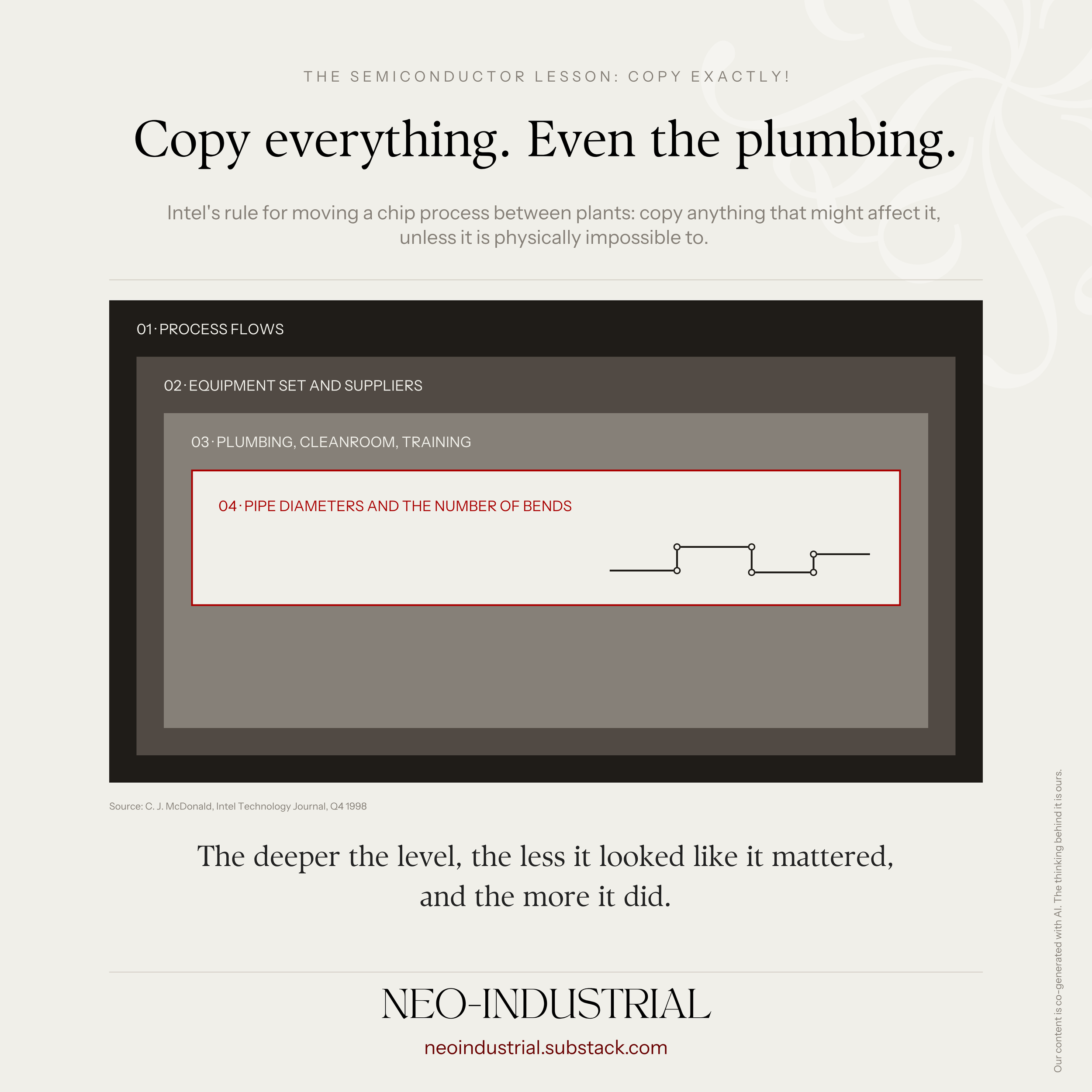
In 1998 Intel published, in its own Technology Journal, a description of how it moves a chip process from the development fab to the factories that run it in volume. The method is called Copy EXACTLY! (the capitals and the exclamation mark are Intel’s, not mine), and its instruction is as literal as its name: copy everything that might affect the process, or how it is run, down to the finest detail, unless it is physically impossible or there is an overwhelming competitive benefit in changing it. Process flows, equipment set, suppliers, plumbing, cleanroom, training methods, and, in the paper’s own words, the diameters of piping and the number of bends. The reason given is that variables long dismissed as second-order effects, barometric pressure, the temperature of the ultra-pure rinse water, turned out to determine yield; the length of an electrode cooling hose once had a catastrophic effect1. And there is a rule in there that I find even more remarkable than the duplication: when a transferred process does not match, engineers are forbidden to make a compensating adjustment, because the adjustment may act on an interacting parameter nobody is measuring.
“Complete causal understanding is not a prerequisite for manufacturing excellence.”
I stumbled across the paper a while ago as I was trying to understand why biology’s last borrowing from semiconductors had gone so badly, and it resonated, a lot. Here was one of, if not the most successful manufacturing industry in history admitting, in writing, that it does not understand its own process, and substituting discipline for theory, showing that complete causal understanding is not a prerequisite for manufacturing excellence. It is also, and I will spend the rest of this essay explaining why, one of the most useful documents anybody in industrial biotech could read this year. And it’s not about biology at all.
A generation of molecules that cannot be made
Something has happened in the last three to five years that, as far as I can tell, has no precedent in biology: the design of molecules became cheap, fast and abundant, and the ability to manufacture them did not move at all.
“The design of molecules became cheap, fast and abundant, and the ability to manufacture them did not move at all.”
The cost curves tell the first half. DNA synthesis has fallen from roughly $25 per base in 1999 to about $0.07 today. Sequencing a human genome cost around ten million dollars in 2007 and costs a few hundred now, and under a hundred from some vendors2. The 2024 Nobel Prize in Chemistry recognised computational protein structure prediction and design as solved enough to be honoured, and the models that do it (AlphaFold and its successors, ESM, RFdiffusion, Boltz) are substantially open, which means the capability diffused rather than concentrated.
The capital followed. Venture funding into AI-driven drug and molecule design ran to $3.8 billion in 2025 on a narrow definition and $11.0 billion across 348 rounds on a broader one, up from $8.9 billion and 264 rounds the year before. Isomorphic Labs raised a $600 million Series A in March 2025 and a $2.1 billion Series B in May 2026. EvolutionaryScale raised $142 million at seed. Chai Discovery went from a $30 million seed in September 2024 to a $3.8 billion valuation in July 2026, twenty-two months3. Cradle, Profluent, Basecamp, Latent Labs, Generate, Lila: the list is long and lengthening.
Now the second half, which is the one that matters, to me at least. Almost none of these companies can manufacture anything. This is not meant as a criticism, quite the opposite, it is a deliberate design choice: their asset is a model and a dataset, and their capital efficiency depends on not owning steel. Some own a wet lab for validation, a few own robotic experimentation, essentially none own fermentation capacity, downstream processing at scale, or a route to a manufactured kilogram. Adaptyv Bio exists precisely to be the physical layer the others rent, and its own numbers show the shape of the problem: in one recent campaign, 1,320 designed binders went into its automated lab against sixteen targets, and 354 of them bound4. One could say, designing them was the easy part.
So we have arrived somewhere new. The design of molecules has been democratised, the manufacture of molecules has not, and the second problem is now the one that decides which designed molecules ever become products. I made that argument at length in Biological AI: There Will Be No AlphaFold Moment for Biomanufacturing. What follows is about the one industry that has already lived through this, and what it did about it.
The wrong half
Biology has borrowed from semiconductors before, and it went badly. That history has to be dealt with honestly before the comparison can be used again.
The previous wave of synthetic biology, in the 2010s, analogised to chip design. The vocabulary was explicit: standard parts, registries, genetic circuits, logic gates, “engineering biology”. The ambition was compositional, characterise a component once, reuse it anywhere, predict an assembly’s behaviour from its parts, in true reductionist fashion. It failed for a physical reason, not for lack of talent. Electronic modularity rests on spatial insulation: two transistors never interact unless a wire connects them, so a device model characterised in one circuit holds in another. A cell offers no such insulation. It has one cytoplasm, one ribosome pool, one metabolic budget, and everything competes for all three. The literature named the consequences precisely (context dependence, retroactivity, downstream modules altering the dynamics of upstream ones as Gyorgy and Del Vecchio formalised in 2014, resource competition and host burden) and concluded, in the field’s own words rather than its critics’, that circuits require ad hoc redesign in every new context5. Abstraction hierarchies need insulation. Biology does not provide it. The design analogy was, in other words, more than optimistic: it demanded a property that biology simply does not have.
But let’s consider the other half of the same industry, the half that runs the fab. A modern semiconductor fab is not a reductionist system, far from it, and it is not run as one. Nobody derives yield alone from first principles. Intel’s own account of why it adopted Copy EXACTLY! is explicit: process flows with many steps held to close tolerances, complex interactions in which each step affects many others, final device parameters determined by many inputs, with the consequence that supposedly second-order variables decide the result. Hence the duplication down to the pipe bends, and hence the prohibition on compensating adjustments. This is the opposite of reductionism: an institutional admission that the process is not fully understood, that unknown couplings exist, and that discipline must therefore stand in for theory.
So, instead of biology behaving like electronics, here is what we should have learned: semiconductor manufacturing is one of, if not the most successful case in industrial history of obtaining predictable, high-yield output from a physical process that cannot be derived from first principles. Industrialising biology is a problem of the same class, and a harder instance of it. Harder, because a fab process does not fight back, whereas populations of cells drift, revert and adapt; because wafers can be measured destructively at any step and cells largely cannot; and because where a fab has physics to fall back on, biology has no complete first-principles model of a living population in a large vessel. Every one of those differences is an argument for more measurement and more validation in steel, not for more abstraction.
"Every one of those differences is an argument for more measurement and more validation in steel, not for more abstraction."
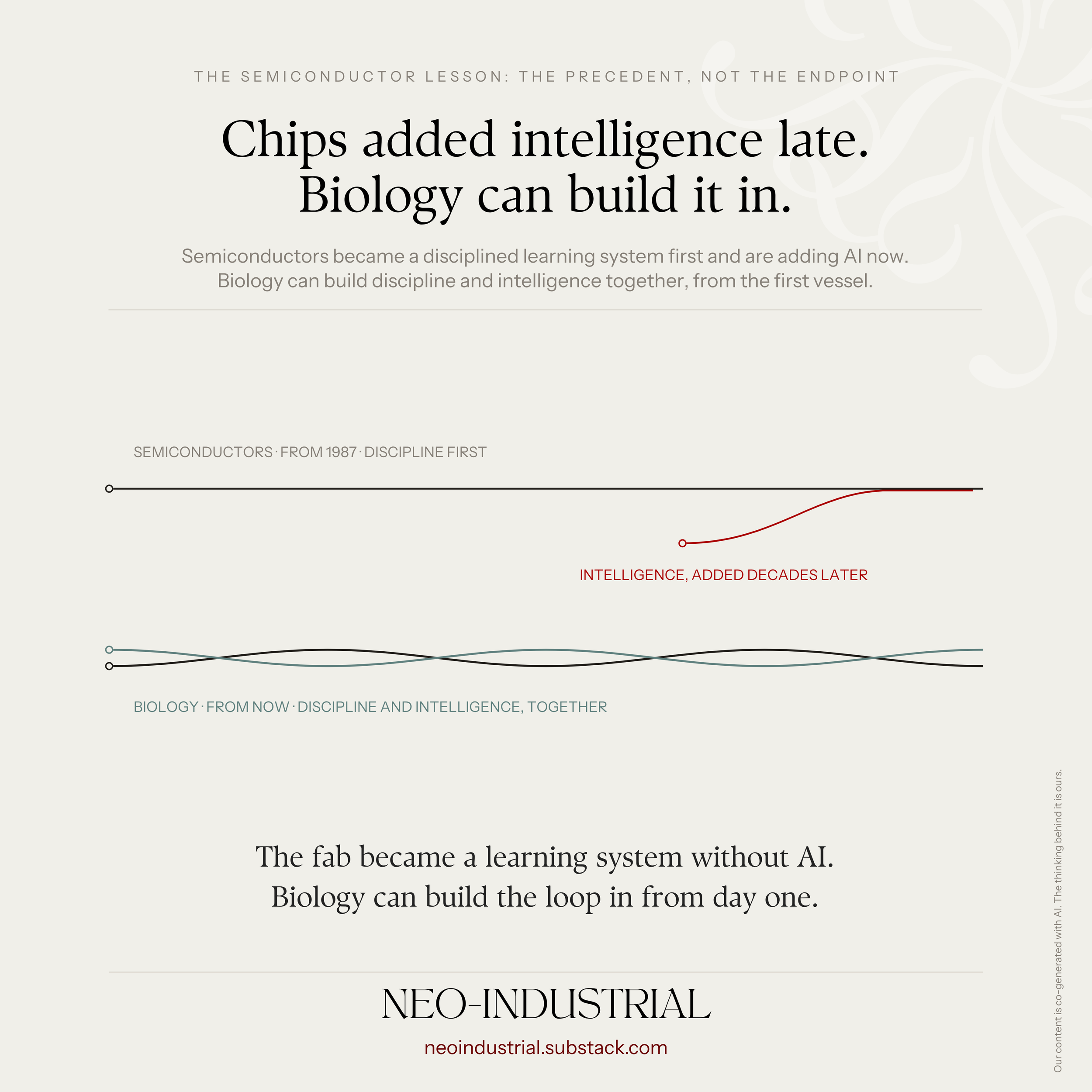
To close the paragraph, one important qualification needs to be made. Semiconductor manufacturing solved the yield problem long before AI became the intelligence layer it is now becoming. Its intelligence accumulated in process engineers, metrology systems, statistical models, automation and production learning over decades. Modern fabs are increasingly adding machine learning and AI to that stack, but the architecture was built first. Biology has the opportunity to start from the other direction: to build the physical infrastructure and the intelligence layer together from the beginning. If we look at this from the Neo-Industrial angle, the semiconductor fab is not the Neo-Industrial company. It is the industrial precedent from which the Neo-Industrial company can now learn and build on top of it.
What a fab actually sells
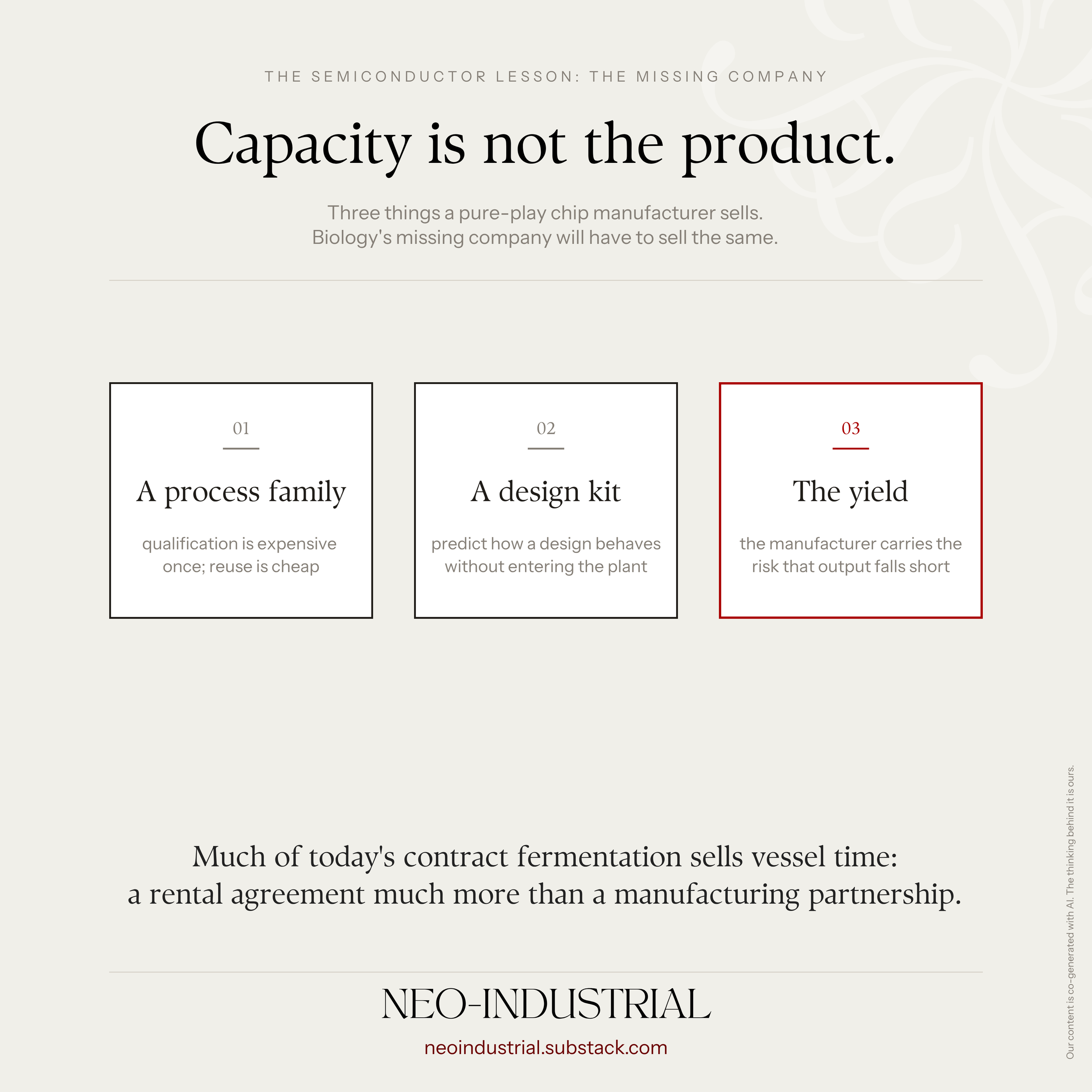
Looked at closely, a pure-play contract manufacturer of chips sells three things, and, surprise, none of them is capacity.
A qualified process family.
Not a factory and not a service, rather a characterised manufacturing configuration with known envelopes, reusable across products that have nothing in common. Qualification is expensive once and reuse is comparatively cheap. In biology the equivalent is narrower, a family is bounded by host and product class rather than universal, but the economic logic is the same: the second molecule inside a qualified envelope should not cost what the first one did.
A design kit.
In semiconductors this is the artefact that makes the whole relationship possible, and one of the least discussed outside the industry: a package of models, design rules and verification decks that lets a designer who has never entered the plant predict how a design will behave when built. Obey the rules and it works. And, this is the point, it is not a theory of physics, rather a manufacturability envelope, empirical, statistical, plant-specific, versioned, and shipped with explicit statements of what has and has not been characterised. That distinction is what rescues the idea from the failure described in the previous section. The design analogy tried to write biology’s datasheet. A design kit is a set of design rules. A datasheet claims to describe how a part behaves anywhere; design rules describe only what one plant can build. The first is a theory of biology, the second a bounded, measured claim about your own steel, which is, in my view, the only kind of claim anyone in this field should be making.
“A datasheet claims to describe how a part behaves anywhere; design rules describe only what one plant can build.”
And yield.
The moat is neither the building nor the equipment. In theory, anyone can buy the same lithography scanners; but nobody can acquire the accumulated knowledge of how a specific process behaves, which improves with every wafer and cannot be reconstructed from outside. Translated commercially, yield means one thing: the manufacturer carries the risk that output falls short.
Looked at this way, the line between what exists in biology today and what does not becomes very sharp. Much of today’s contract fermentation market effectively sells vessel time. It does not guarantee titre, yield or cost of goods at a scale it has not run. The customer brings a process and carries every consequence of that process failing to scale. That is a rental agreement much more than a manufacturing partnership, and it is why a molecule owner with no plant is not actually served by the capacity that exists, beyond the rental.
Why „fab-like“ is a necessity
Two recent developments compound the need for a transition to a fab-like model.
The design population now exists, and it did not before.
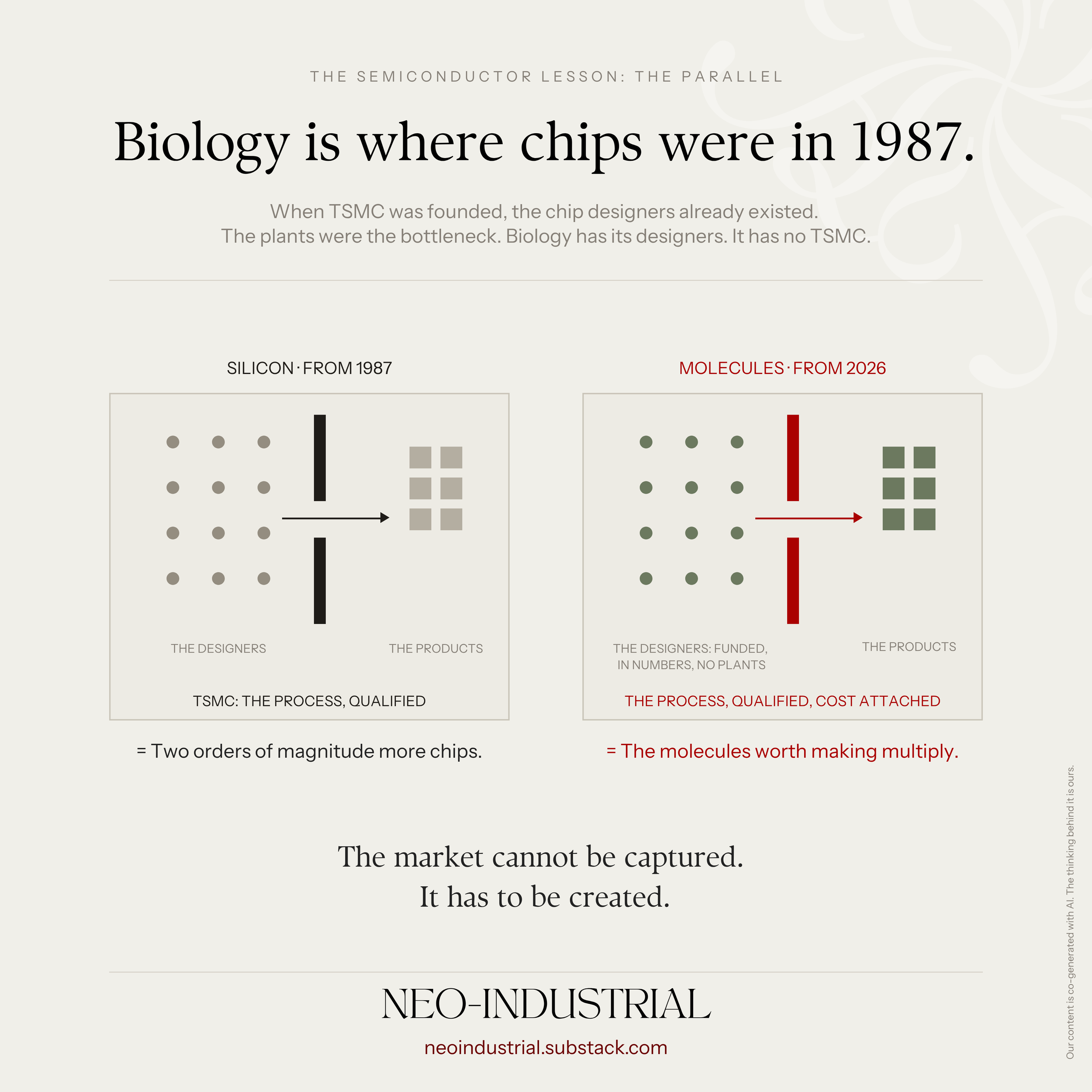
When TSMC was founded in 1987 there was no waiting cohort of design-only customers. Practically every chip company still owned a fab, and for its first years the new company survived on overflow and specialty work, the industry’s leftovers. Morris Chang’s confidence did not come from market research, rather from an observation made during his years at Texas Instruments: many circuit designers wanted to start their own companies and were blocked by the cost of a plant6. The parallel is a very close one, and it is what makes this a “now” argument. The blocking cost has moved. What stops a molecule designer today is not the cost of designing, which has collapsed, rather the cost and risk of getting from a designed molecule to a manufactured one. And unlike 1987, the designers already exist, funded, in numbers, with models and no plants.
Better design tooling makes the problem worse, not better.
A contract manufacturer’s implicit assumption is that an incoming molecule resembles what it already makes; de novo proteins and non-natural scaffolds increasingly do not. So every advance in design capability enlarges the population of molecules that exist on paper and cannot be made by an existing plant. The bottleneck, in other words, does not dissolve under more design, quite the opposite, it grows. And the evidence that the make step is genuinely unsolved is not anecdotal: a 2025 review in Trends in Biotechnology concluded that the field still lacks a predictive model of soluble protein expression and named the absence of large, high-fidelity datasets as the bottleneck, and a benchmark of 614 experimentally characterised designs found that AlphaFold, ESMFold and ProteinMPNN discriminate successes from failures only moderately, with many failed designs scoring better than successful ones7. Design has run ahead of the ability to test, let alone to produce.
“Every advance in design capability enlarges the population of molecules that exist on paper and cannot be made by an existing plant.”
And the economics of the making step are brutal in a way the design economics are not. Developing a commercial fermentation product has been estimated at 10 to 20 years and $70 to $150 million; full scale-up including a plant at $100 million to $1 billion, with three to ten years from lab to manufacturing8. Downstream processing accounts for 50 to 80 percent of production cost across biologics, enzymes and fermentation products: the money goes much less into the molecule than into getting it out of the broth. The price thresholds are unforgiving: Konzock and Nielsen put commodity chemicals at roughly $1–3 per kilogram, specialty chemicals above $5 and fine chemicals above $109, and most designed molecules are nowhere near their threshold. And the capacity that exists is in the wrong places and the wrong sizes: China holds more than 70 percent of global fermentation capacity on its own ministry’s figures, and of the 246 facilities across 40 countries catalogued in Synonym’s survey, the majority are bench or pilot scale10. There is very little in the middle, which is exactly where a molecule with tens of millions of dollars of annual revenue would need to be made.
A few words of caution
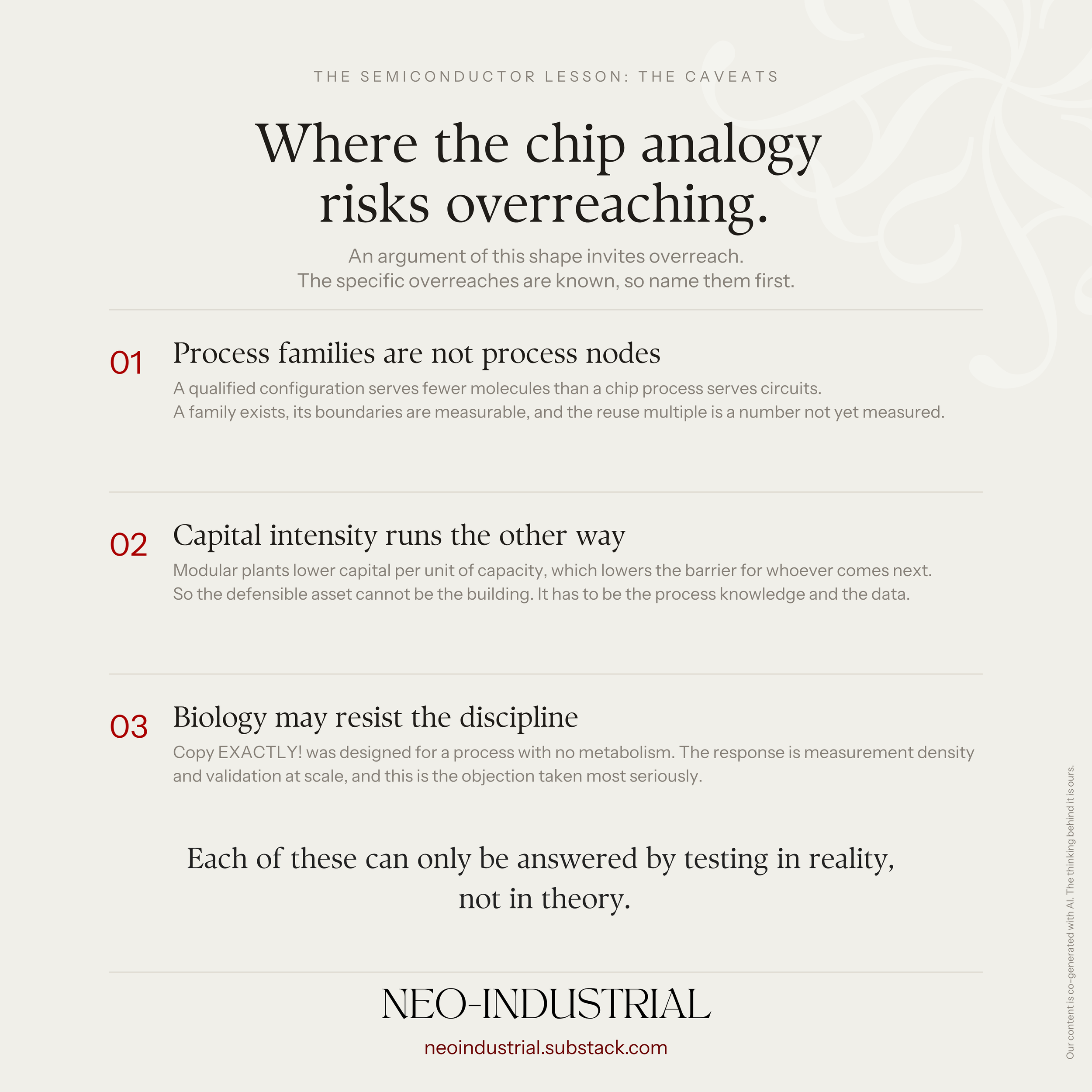
The argument is powerful, and the risk of overstretching it is real. Three counter arguments need consideration.
Process families are not process nodes.
One semiconductor node runs hundreds of unrelated products. A qualified fermentation configuration will serve far fewer molecules, because host and recovery train are more entangled with the product than a fab process is with a circuit. Platform processes and host libraries are real and used commercially, but they are bounded by host and product class, and anyone claiming that fermentation process knowledge transfers freely across molecules and organisms is claiming something the literature does not support. The more accurate version is that a family exists, that its boundaries are measurable, and that the reuse multiple is a number we have not measured, yet.Capital intensity runs the other way, and is a genuine tension (at least seen through my Arsenale eyes).
TSMC’s position deepened as fabs became more expensive; rising capital intensity was itself the barrier. Modular, replicated plant designs such as the ones we plan to build do the opposite, they lower capital per unit of capacity, which lowers the barrier for whoever comes next. That’s a fair observation. Two things temper it. First, the absolute capital required to establish meaningful capacity remains large enough to deter most entrants. Second, cheaper steel means the defensible asset cannot be the building or the hardware. It has to be the process knowledge and the data, which was always true of TSMC as well.Biology may resist the discipline more than chips did.
Context dependence is not a solved problem, and Copy EXACTLY! was designed for a process with no metabolism. It is entirely possible that biological variability limits how far manufacturing discipline can be pushed. My instinct is that the response is measurement density and validation at scale rather than abstraction, but this is the objection I take most seriously, and it can only be answered by testing in reality, not in theory.“Copy EXACTLY! was designed for a process with no metabolism.”
The need for vertical integration
There is a question inside the semiconductor analogy that is usually skipped, and for biology it turns out to be a very interesting one: is the defensible position the manufacturer or the instrument maker? ASML sells the lithography tool; TSMC uses tools to sell qualified manufacturing. Both are formidable, and ASML’s monopoly on extreme-ultraviolet lithography is arguably the stronger position, because everyone has to buy from it.
“The boundary has to be vertical because the protocols that would allow it to be horizontal do not yet exist.”
In semiconductors those are separate companies, and they can be, because the physics of a lithography tool is understood independently of the process it serves, and because a market for the tool existed before the toolmaker specialised. An earlier draft of this essay claimed that in biology the two cannot be separated, full stop. Matteo Zanotto, my co-founder, pushed back, and he is right: the more accurate claim is that they cannot be separated YET, and the reason is timing rather than physics. Buyers have not recognised the need for something more sophisticated than a well-made tank, so instrument makers have not built for a market they do not believe exists. We would have bought our 500 L development reactor from an established vendor if one had existed with the sensing we needed, ready to ship. None did. So the process design capability and the instrumentation that measures the variables it designs against have to be built by the same hands, for now. It is the vertical phase Matteo and I described in Neo-Industrial Companies Are Inference Machines: the boundary has to be vertical because the protocols that would allow it to be horizontal do not yet exist.
So, as any Neo-Industrial company today, Arsenale holds both positions deliberately, as a consequence of the moment rather than as a doctrine. The instrument side is the Piccolo reactor, the sensing and control suite built around it, and the modular hardware that carries the same instrumentation up the scale ladder. The manufacturing side is the process design method, validation at industrial scale, and production. Each is what makes the other possible today. Whether they stay under one roof when the market matures is a question I am happy to leave open. But for the time being they must be under the same roof.
Thou shall not compete with your customer
TSMC’s customers hand over their most valuable intellectual property, and they do so for a reason that has nothing to do with technology: the company is structurally incapable of competing with them. It makes no chips of its own. Chang built the company on the principle of never competing with a customer, and he did so against a specific memory: firms with their own fabs had sold foundry services in downturns, thrown those customers off the line when demand recovered, and in some cases copied their designs. The contrast cases are still instructive: manufacturers that also sell competing end products have persistent trust problems with the customers they compete with, whatever their technical capability.
“This is a piece of the analogy that is very easy to overlook but very hard to retrofit, because it is a structural decision rather than a promise.”
This is a piece of the analogy that is very easy to overlook but very hard to retrofit, because it is a structural decision rather than a promise. Arsenale owns no molecules. We do not develop products to sell and we do not build a portfolio. The molecule, the commercial product and the market belong to the client; the manufacturing learnings and the accumulated process knowledge are ours. That division has very practical consequences. It means our commercial interest cannot diverge from the client’s on the thing that matters, whether their molecule gets cheap enough to sell, and it removes an objection that would otherwise be hard to counter, that a company advising on process design might be steering molecules toward its own ambitions.
What does a Biology “fab” look like?
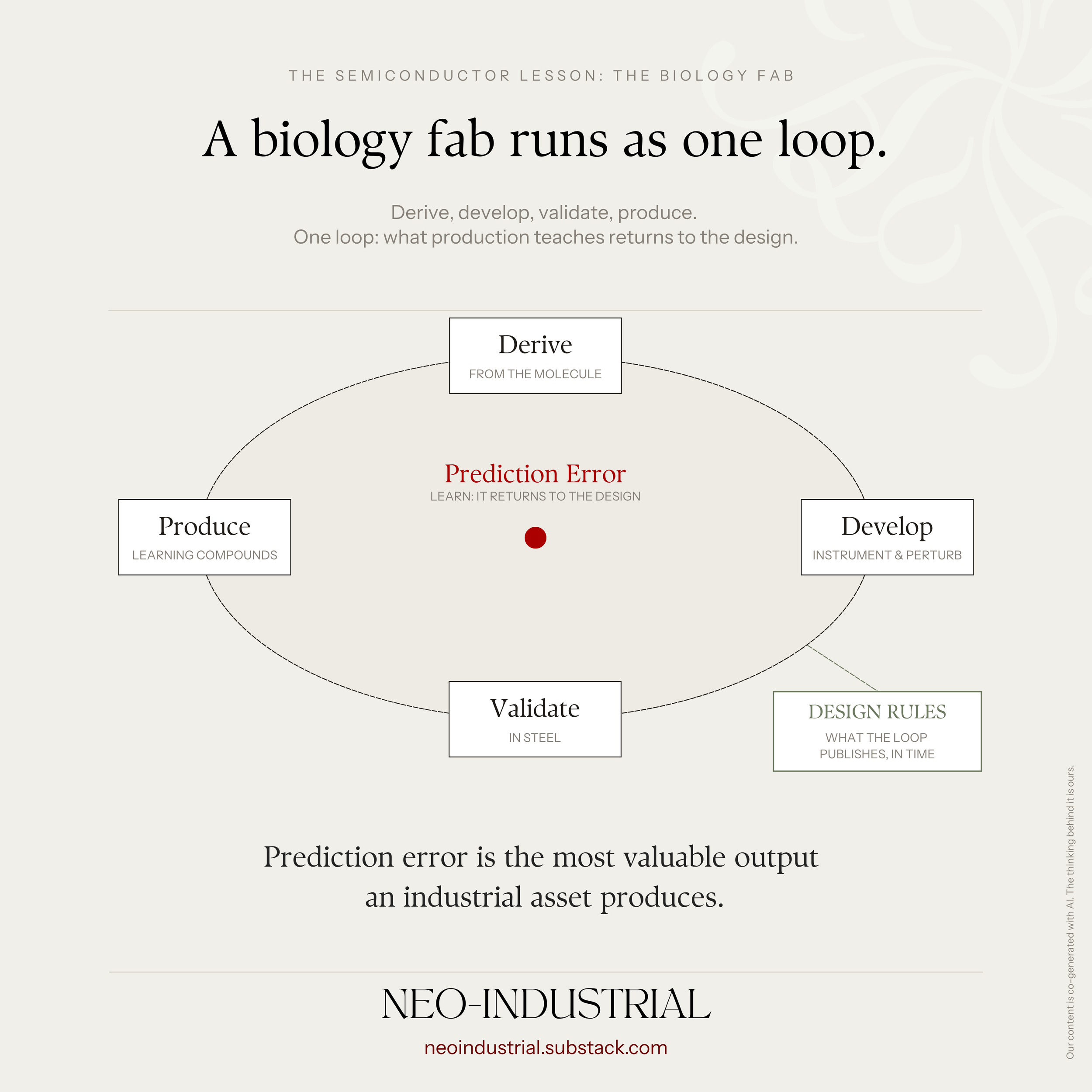
The more I dug into the fab analogy, the better it worked for biology too. So I had to extrapolate what the characteristics of a fab would be in a biological context. Admittedly, the characteristics that came out are also Arsenale’s. By design, not by chance. Five and a half of them, and the territory gets more technical from here.
A method that runs in the right order.
The production process is derived from the molecule rather than from the equipment. With a caveat. We have come to understand that very little about a process is fixed single-handedly by the molecule itself. Where the product ends up, how stable it is in real broth, and the concentration at which it inhibits its own producer are properties of the system, molecule plus organism plus medium plus mode, and they have to be measured rather than looked up. So the method enumerates the technically plausible routes, eliminates in silico everything that thermodynamics, stoichiometry, known separation limits or the regulatory position already exclude, and designs what survives as a system, fermentation and recovery together, with downstream holding the casting vote when they conflict.“The strain specification is an output of that loop, not an input to it.”
The strain specification is an output of that loop, not an input to it. And it is not only us saying so: Crater and Lievense, reviewing industrial scale-up in 2018, name as a common fundamental error the selection of a host without regard for its suitability for large-scale production. The conventional order (molecule first, then strain, then process) guarantees that error, because the host is chosen before anyone has established what the plant will need.
Instruments that measure what the industry infers.
Titre is the easiest thing to measure, which is why everyone optimises it and why optimising it is not a differentiated activity. Our development reactors carry a deliberately over-specified sensing stack, because a variable that is not observed cannot be optimised, and the variables that decide cost in fermentation (broth viscosity, debris and lysis load, conductivity at harvest, secreted fraction, foaming burden, proteolytic load) are the ones conventional plants rarely measure in line or at line. Instrumenting them converts a dataset of conditions into a dataset of conditions to biology to outcomes to downstream cost, on the same broth. We have looked for such a dataset and not found one. It cannot be scraped, bought or simulated. It has to be made.Development that is perturbed, because perturbation is what identifies cause.
A model built from routine batches learns which signals happen to move together: in fed-batch, substrate falls while product rises, so a model can predict product through an incidental relationship that carries no information the moment the process changes. Deliberately disturbing the culture (a substrate pulse, an oxygen step, a pressure change) breaks that covariance, and breaking it is what lets causal structure be identified. Causal structure transfers across hosts, modes and scales, correlation does not, and this is why our runs are interventions rather than observations, and why what a run is worth is its response trajectory rather than its endpoint titre.Validation in steel.
Computational iteration is where clockspeed comes from, and it is not optional, but a model that is never anchored back to reality accumulates confident error (Matteo and I described the pathology in “Inference Machines“ and will not repeat it). So processes are validated at industrial scale on reconfigurable lines, and every campaign is an explicit test of what the bench predicted, recorded against a declared tolerance.Production, because a process that is not operated cannot be improved.
An industrial process running continuously is the densest source of information the whole system generates: real feedstock, real variability, hundreds of batches, at the scale where the economics are decided. It does three things at once. It improves the process it is running, it corrects the design method where reality departed from prediction, and it qualifies the configuration so that the next molecule inside that envelope does not start from zero.
And, in time, design rules.
The manufacturability envelope (which molecules a qualified configuration admits, and what a strain must do to run in it) is what would allow someone else to design into our plant without entering it. We hold it in versioned form already, and we might make it available, but not before it has been validated, and validated means it has held on a molecule the configuration was not designed around.
If we put the two side by side, the translation is very legible. The fab on the left, what each of its characteristics becomes in biology in the middle, and on the right the place where the copy stops.
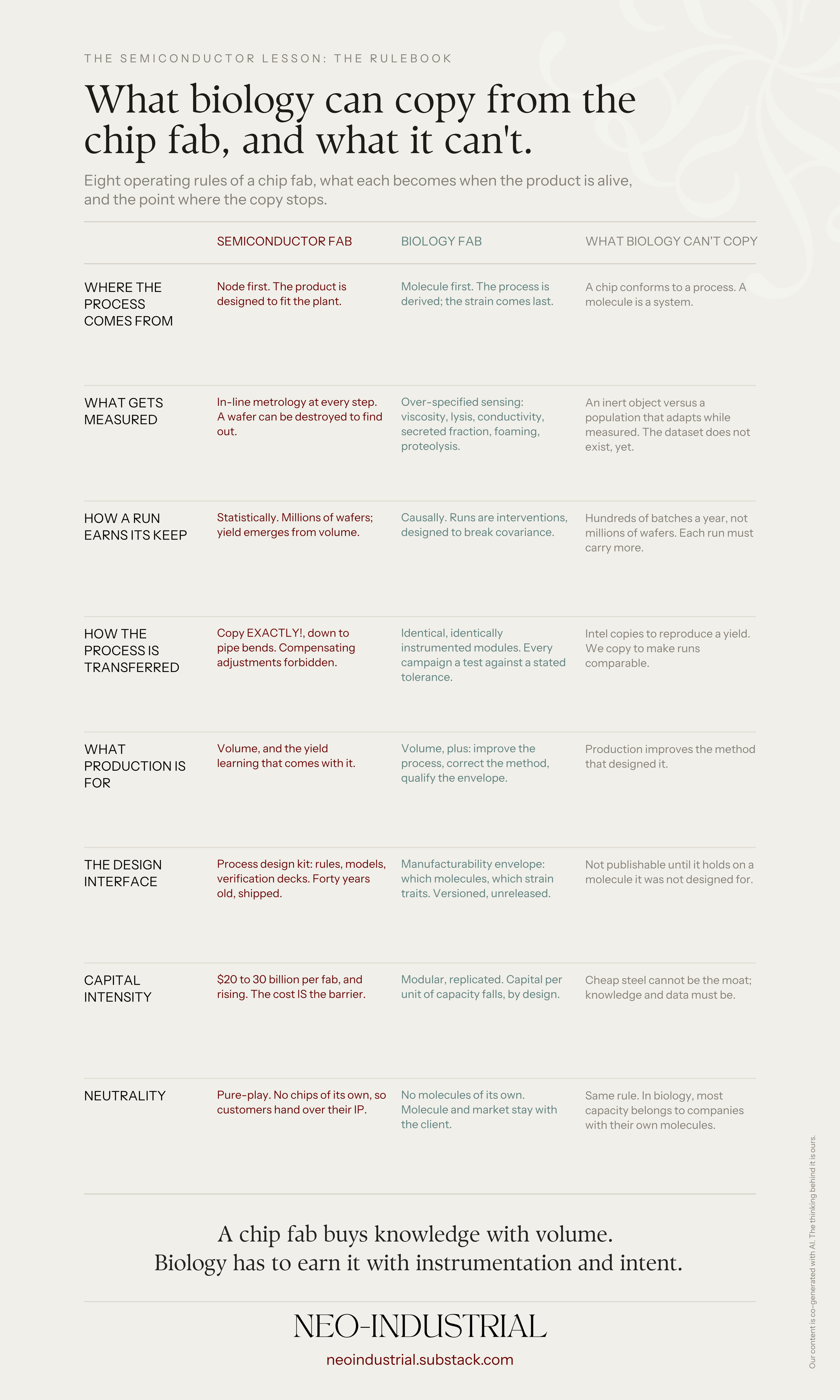
Table figures11
While reading the right-hand column, the pattern is consistent. Wherever the fab can spend volume to buy knowledge, biology cannot, and has to spend instrumentation and intent instead. That is the whole design brief, and it is why the instrument and the method cannot yet be separated.
“Wherever the fab can spend volume to buy knowledge, biology cannot, and has to spend instrumentation and intent instead."
The machine nobody has built
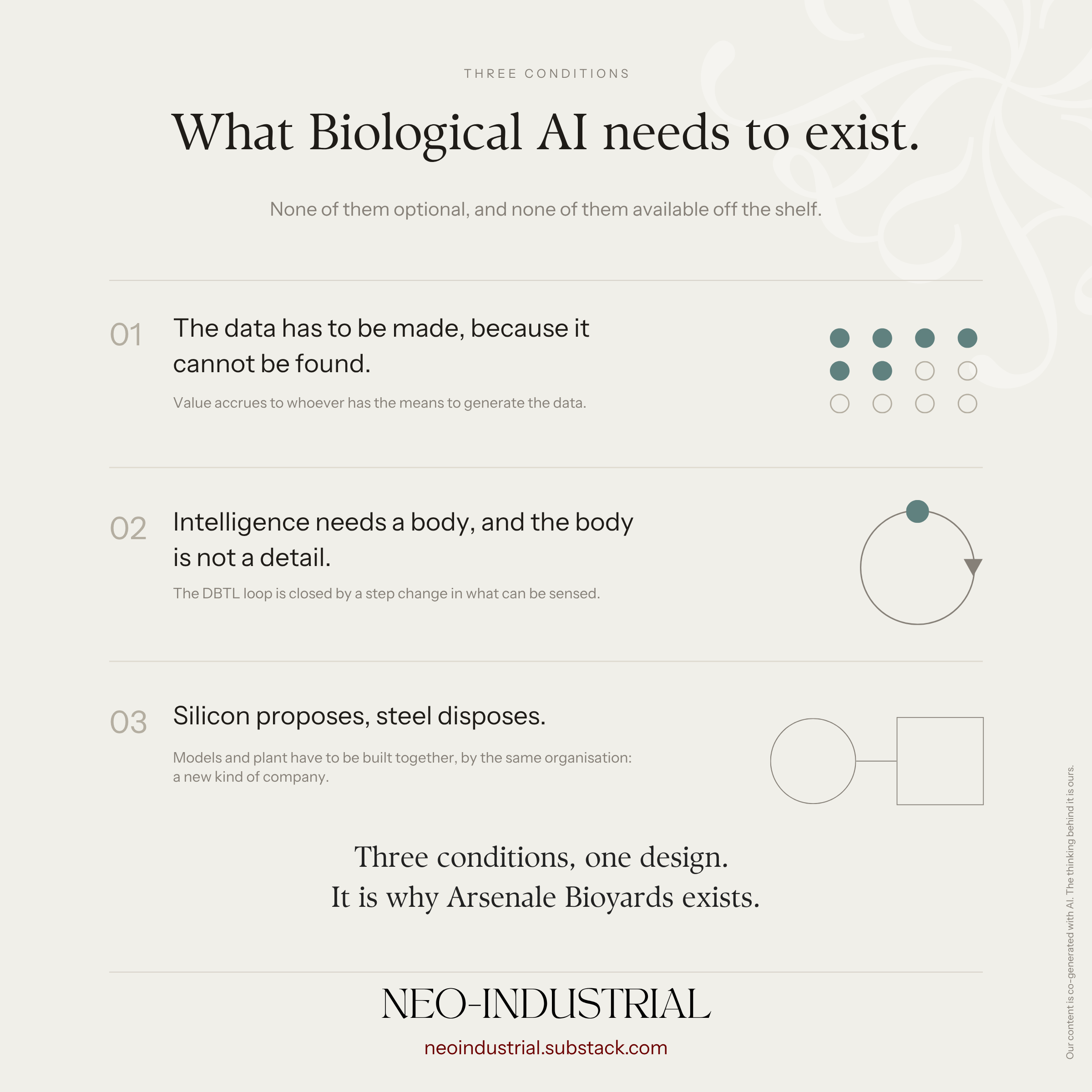
The last five years produced an extraordinary capability: the ability to design biological molecules that nature has not made and chemistry cannot reach. The next five will be decided by something much less glamorous, whether anyone can manufacture them at a cost someone will pay.
This is, in my view, not a design problem that better models of molecules will solve, rather a manufacturing problem of the specific kind semiconductors solved forty years ago: predictable output from a physical process that cannot be derived, obtained by instrumenting it densely, learning empirically, transferring with discipline, and carrying the risk on behalf of the customer. Biology has had companies that tried to do this on the design side. On the manufacturing side it has not had one so far, and the design cohort that now needs it has just come into existence, has exploded in terms of volume, speed by which it is arising and complexity by which it operates.
We are building it, not because vertical integration is fashionable, rather because the data that makes it possible does not exist and, reasoning from the structure of the problem rather than from evidence, can only be made by whoever holds the whole chain.
Semiconductors showed how to turn a partially understood manufacturing system into a disciplined learning system. AI now makes it possible to build that learning loop as an integral part of the Neo-Industrial company itself.
“Anyone can buy the machines, in semiconductors. Nobody can buy the yield. In biology, nobody has even built the machines, yet.”
Ultimately, anyone can buy the machines, in semiconductors. Nobody can buy the yield. In biology, nobody has even built the machines, yet.
A special thank you goes to Jonas Moeller, Cam Watson , Dirk van der Kley, Andreas Worberg, Mickey McManus, Andras Forgcas, matteo zanotto and the whole Arsenale Bioyards team for their thoughtful inputs, which improved this piece significantly, and to Nicole Laurence for the amazing support in editing and publishing.
This essay is the fourth in the series on the architecture of Neo-Industrial Companies. “The Neo-Industrial Age“ defined the form and its ten pillars, “The Generative Phenotype“ introduced the Digital Original, and “Neo-Industrial Companies Are Inference Machines“, written with Matteo Zanotto, named the intelligence at the centre of the form. A future companion piece, “The Semiconductor Lesson Biology Has not Learned”, develops the semiconductor analogy that is only sketched here.
Notes and Sources:
Copy EXACTLY! C. J. McDonald, "The Evolution of Intel's Copy EXACTLY! Technology Transfer Method", Intel Technology Journal, Q4 1998, pp. 11–15, and "Copy EXACTLY! A Paradigm Shift in Technology Transfer Method", IEEE Advanced Semiconductor Manufacturing Conference, 1997. The paper states the philosophy as copying everything that might affect the process or how it is run, down to the finest detail, unless physically impossible or overwhelmingly beneficial to change; names barometric pressure and ultra-pure rinse water temperature as former second-order effects that now matter; requires matching "down to the diameters of piping and the number of bends"; and warns that it is vitally important to avoid the temptation to make a compensating adjustment, because an adjustment may mismatch an interacting parameter that is not being measured. The problem it was built to solve had a name inside Intel, the "Intel U": a predictable drop in yield every time a technology was transferred to manufacturing.
Cost curves. Gene synthesis: about $25 per base in 1999 to roughly $0.07 today (1centbp.com, built on Rob Carlson's cost curves). Sequencing: NHGRI's cost-per-genome series puts 2007 at roughly $10 million, below $1 million in late 2008 and about $500 in 2022; Ultima Genomics offered an $80 genome in February 2025. The Human Genome Project itself cost about $2.7 billion and finished in 2003.
The design cohort. PitchBook counts $3.8 billion of global VC into AI drug discovery in 2025, its second-highest year on record. DealForma, on a broader definition, counts 348 venture rounds raising $11.0 billion in 2025, against 264 rounds and $8.9 billion in 2024. Isomorphic Labs: $600 million Series A, March 2025; $2.1 billion Series B, May 2026. Chai Discovery: $30 million seed September 2024, $70 million Series A at $550 million August 2025, $130 million Series B at $1.3 billion December 2025, $400 million Series C at $3.8 billion on 14 July 2026. EvolutionaryScale: $142 million seed, 2024.
Adaptyv. The Lausanne company runs an automated wet lab that protein designers rent through a web platform or an API, and raised a $40 million Series A led by Highland Europe in 2026. The campaign cited is its collaboration with Anthropic: Claude designed binders against sixteen targets, 1,320 designs were tested in Adaptyv's lab, and 354 bound, an average hit rate of 26.8 percent.
Why the design analogy failed. A. Gyorgy and D. Del Vecchio, PLoS Computational Biology 10(3), 2014, on modular composition and retroactivity; S. Cardinale and A. P. Arkin, "Contextualizing context for synthetic biology", Biotechnology Journal 7(7), 2012.
TSMC. Founded 1987 with capital of about $145 million, Taiwan's government holding 48.3 percent and Philips 27.6 percent. Chang's observation at Texas Instruments, that chip designers wanted to start their own companies and could not raise enough to build a fab, is recorded in the IEEE and Stanford accounts of his career; the early business consisted of overflow and specialty work for companies that had their own fabs. The neutrality principle, and the memory of foundry customers being thrown off the line when demand recovered and in some cases having their designs copied, is documented in the Computer History Museum's account of the founding.
Expression and design success. C. Baranowski et al., "Can protein expression be 'solved'?", Trends in Biotechnology, 2025: the field lacks a predictive model of soluble protein overexpression, and the primary bottleneck is the absence of large, high-fidelity datasets. M. Garcia, S. M. Dixit and G. J. Rocklin, "Evaluating zero-shot prediction of monomeric protein design success by AlphaFold, ESMFold, and ProteinMPNN", Protein Science, 2026 (doi:10.1002/pro.70453): a benchmark of 614 experimentally characterised de novo monomers from eleven design studies, on which all models showed moderate discrimination, many failed designs scored better than successful ones, and confidence metrics were topology-dependent.
Development and scale-up economics. AIChE/SBE, Chemical Engineering Progress supplement, June 2016: improving strains and optimising scalable fermentation and recovery typically takes 10–20 years and $70–150 million. J. S. Crater and J. C. Lievense (both then at Genomatica), "Scale-up of industrial microbial processes", FEMS Microbiology Letters 365(13), 2018, fny138: scale-up to manufacturing scale, including pilot and demo validation and plant construction and start-up, on the order of $100 million to $1 billion, typically 3–10 years, with piloting alone at 5–20 percent of total project cost; and, on host choice, "a common fundamental error is to select the microbial host strain and develop it without regard for its suitability for large-scale production".
Price thresholds. O. Konzock and J. Nielsen, "TRYing to evaluate production costs in microbial biotechnology", Trends in Biotechnology 42(11), 2024, 1339–1347: commodity chemicals sell at around $1–3/kg, specialty chemicals typically above $5/kg, fine chemicals typically above $10/kg (penicillin, now a semi-commodity at more than 60,000 tonnes a year, sits at about $10/kg).
Capacity. The 70 percent figure is China's own: He Yaqiong, director of the consumer goods department at the Ministry of Industry and Information Technology, told a biomanufacturing forum in September 2025 that China accounts for more than 70 percent of global fermentation capacity. Facility counts from Synonym's Capacitor database and its "State of Global Fermentation" report: 246 facilities across 40 countries in the updated edition, most of them bench or pilot scale. Synonym has since renamed itself Roebling.
Table figures. Leading-edge fab capital cost of $20–30 billion is an industry-reported range, not a company figure. The fermentation capital comparison is Liberation Labs' Richmond, Indiana plant: about $115 million for 600,000 litres of fermentation capacity with dedicated downstream. Downstream processing at 50–80 percent of production cost is a range assembled from multiple sources across biologics, enzymes and fermentation products, and is stated as a range for that reason.