

Deep tech solved discovery. It never solved industrialization. The neo-industrial age is what comes next — and it demands a completely different kind of company.
Foreword
Five years ago, as I was still at BCG, we partnered with Hello Tomorrow to publish a series of three reports, which I co-authored, that sought to define Deep Tech as a distinct approach to innovation (The Great Wave, Nature Co-Design, The Deep Tech Paradox). The thesis was clear: deep tech ventures leverage scientific and engineering advances to solve fundamental problems, massively expanding the option space of possible solutions through accelerated Design-Build-Test-Learn (DBTL) cycles, technology convergence, and problem orientation rather than solution fixation.
That thesis has proven remarkably durable. But my perspective has radically shifted, from analyzing deep tech as a consultant from afar to being on the ground, building a deep tech company as an entrepreneur. And from this “privileged” vantage point, I can see now both what those reports got right and what they missed.
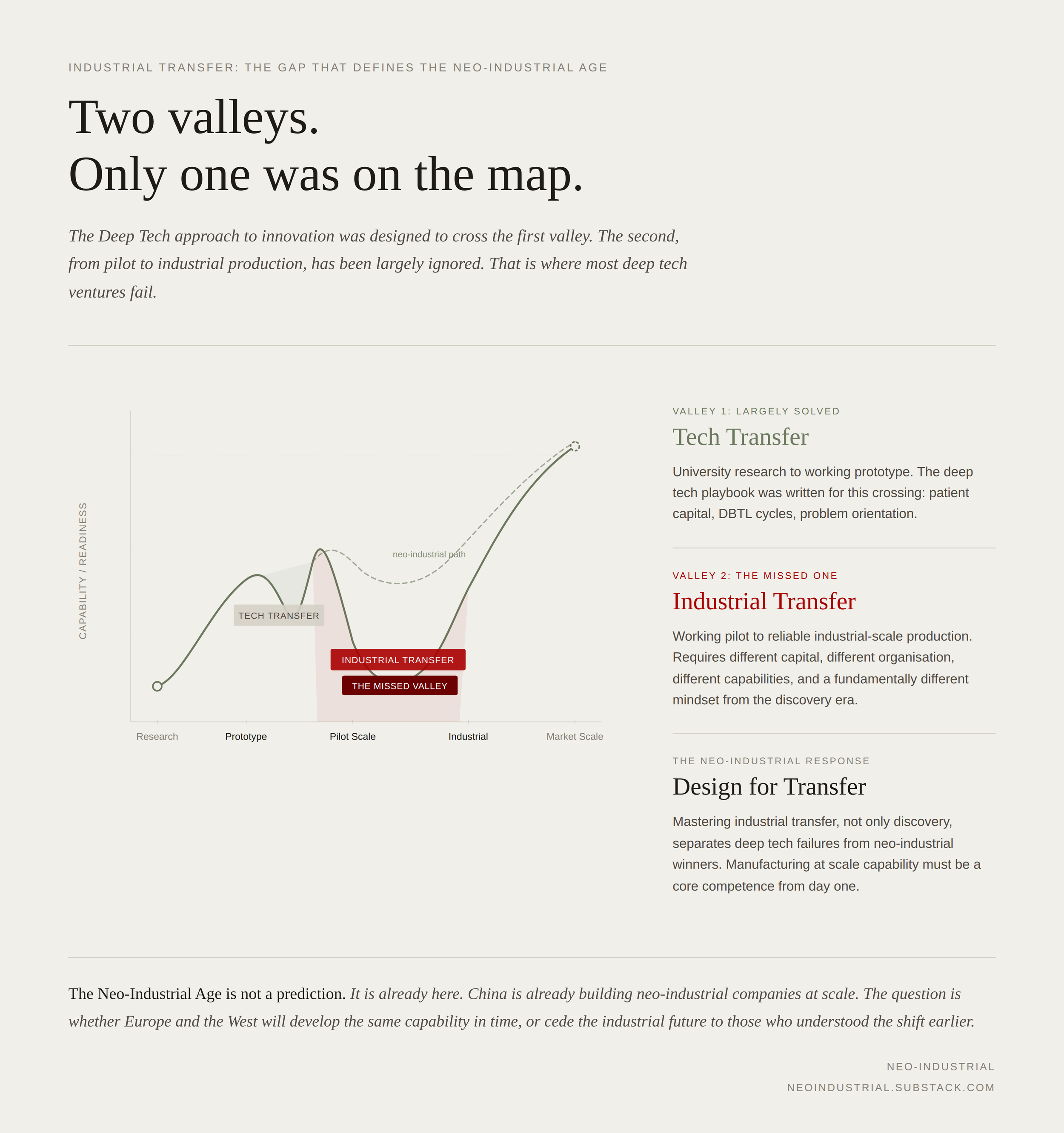
While deep tech succeeded at accelerating discovery, it failed in most instances at scaling production. The defining challenge of the next industrial era is not inventing faster, but transferring innovation into reliable, repeatable, industrial execution. I call this missing capability industrial transfer, and mastering it is what separates deep tech failures from Neo Industrial winners.
What the Deep Tech Reports Got Right
The core innovation engine we described has not only been validated, it has been turbocharged beyond our projections.
The DBTL cycle has been supercharged by AI. When we wrote about the Design-Build-Test-Learn cycle in 2021, we understood it as powerful. We did not anticipate just how profoundly AI would transform it. AlphaFold won the Nobel Prize in 2024 for solving protein structure prediction, a problem that had stumped scientists for fifty years. DeepMind’s GNoME expanded the number of known stable materials from 48,000 to over 421,000 structures. Insilico Medicine demonstrated drug discovery in 18 months at $2.6 million versus traditional timelines of 42+ months and $430+ million. The Design and Learn phases of the DBTL cycle have been accelerated by orders of magnitude.
Technology convergence has intensified. The three-domain convergence we identified - Matter & Energy, Computing & Cognition, Sensing & Motion - has accelerated faster than predicted. But AI has emerged as more than one technology among equals. It has become the universal connector, the accelerating force across all domains. As researchers now write in Nature Communications, the cycle might better be described as “LDBT”: Learning first, then Design, then Build and Test, because AI enables “zero-shot predictions” before any physical experiment begins.
The expanded option space is real and growing. Companies today access solutions that were literally unimaginable in 2021. The option space has expanded exponentially, and AI allows us to navigate it with unprecedented efficiency.
What the Deep Tech Reports Missed: The Industrial Transfer Gap
Here is what we got wrong, or more precisely, incomplete: we focused almost entirely on what is known as “tech transfer”, the movement of innovation from university research to startup prototype. We articulated how to cross the valley of death between laboratory discovery and working technology demonstration.
But there is another valley. A far more dangerous one. And we largely missed it.
The critical gap is “industrial transfer”: the movement from pilot scale to industrial scale manufacturing.
Evidence from 2021-2025 makes this brutally clear:
Zymergen raised $874 million and achieved a $5 billion valuation at IPO in April 2021. By August 2021, the stock had lost 75% of its value overnight. By October 2023, the company was bankrupt. Zymergen had world-class science. Their DBTL cycle worked brilliantly in the lab. Their Hyaline material performed as designed in laboratory conditions. But when it came to manufacturing at scale and integrating with customer production processes, the company failed completely. This was not a tech transfer problem; it was an industrial transfer problem.
Northvolt raised over $15 billion in equity and debt and was once valued at $12 billion, positioned as Europe’s answer to CATL and the continent’s best hope for battery independence. The company filed for bankruptcy in November 2024 (US) and March 2025 (Sweden), the largest bankruptcy in modern Swedish industrial history. What went wrong? Northvolt’s flagship Skellefteå gigafactory was designed for 16 GWh annual production; actual output reached just 1 GWh, less than 0.5% of the target. BMW cancelled a $2 billion contract in June 2024 after Northvolt fell two years behind on deliveries. The company burned $100 million monthly while production remained too low to generate adequate revenue. As one Chinese executive observed: “We can raise a factory’s battery yield to 96% in just four months. Northvolt took four years and only achieved 70%.” The technology existed. The manufacturing execution did not.
Amyris built sprawling infrastructure of industrial fermentation vats, achieved peak revenue of $153 million, accumulated $1.33 billion in debt, and filed for bankruptcy in August 2023, despite multiple pivots from biofuels to cosmetics to consumer brands. Again: the technology worked. The manufacturing at industrial scale and unit economics never did.
The pattern extends beyond synthetic biology and batteries. Lilium burned through $1.5 billion before filing for insolvency in late 2024. Climeworks designed direct air capture facilities for 36,000 tons per year, but actually operates at approximately 105 tons, a gap of over 99%. Across deep tech sectors, the same story repeats: laboratory success followed by manufacturing failure.
The exceptions prove the rule. Commonwealth Fusion Systems has raised over $2.1 billion and represents perhaps the gold standard for industrial transfer thinking—validating enabling technology before commercial commitments, designing SPARC and ARC for parallel development, securing customer commitments (a 200 MW Google PPA) before commercial operations. Form Energy built a pilot facility first, then scaled to commercial production. Sila Nanotechnologies designed for manufacturing from inception. What distinguishes these successes? They treated manufacturing capability as core competence from day one.