

Why Neo-Industrial Companies Are a Different Kind of Being.
Two Kinds of Organization
There are two fundamentally different kinds of industrial organization in the world today. Not two strategies, not two business models, not two corporate cultures: two different kinds of being.
The first kind is established and optimizes for the present. It has been shaped by decades of competition to extract maximum value from existing arrangements: established technologies, known markets, proven processes, familiar supply chains. It is extraordinarily good at what it does. It is an apex predator in its niche, exquisitely adapted to current conditions.
The second kind is nascent and optimizes for what doesn’t yet exist. It is configured not to extract value from existing arrangements but to generate new arrangements: new technologies, new markets, new processes, new supply chains. More fundamentally, it is configured to evolve its own capacity to generate. It doesn’t just create new things; it creates new ways of creating things.
These two kinds of organization look superficially similar. Both have factories, supply chains, R&D departments, and balance sheets. Both make physical products. Both compete in markets.
But they are ontologically different. They operate according to different logics, accumulate different kinds of capability, and relate to intelligence, both human and artificial, in fundamentally different ways. And critically, they operate at different clockspeeds: different metabolic rates of innovation, learning, and adaptation.
Evolutionary biology gives us the language to name this difference: the Ecological Phenotype versus the Generative Phenotype.
In this essay, I will go deep into the biological sphere, as looking at things with a biological perspective is necessary in a complex and fast-changing context, such as the one we are experiencing right now. I will do my best not to go too deep in it, and hope you will come along with me.
Moving out of the biological sphere, the best I can think of to explain the difference between the two kinds of companies goes back to the famous George Bernard Shaw’s quote: “The reasonable man adapts himself to the world: the unreasonable one persists in trying to adapt the world to himself. Therefore, all progress depends on the unreasonable man.” Consider the second type of company as the “unreasonable company”.
The Ecological Phenotype: Adaptation Without Evolution
The incumbent industrial corporation is a triumph of the Ecological Phenotype.In biology, the Ecological Phenotype encompasses the traits actually expressed in an organism’s current life: the specific adaptations useful in today’s struggle for existence. The giraffe’s long neck enables it to reach high leaves. The polar bear’s white fur serves as arctic camouflage. The cheetah’s musculature allows explosive speed. These are exquisite adaptations to specific environmental conditions.Industrial incumbents exhibit the same logic. Over decades of competition, they have been shaped into highly adapted machines for their specific niches. Their processes are optimized for efficiency. Their supply chains are calibrated for cost. Their hierarchies are tuned for command and control. Their institutional knowledge is encoded in procedures, standards, and tacit expertise.This adaptation is genuinely impressive. A modern automotive OEM coordinates thousands of suppliers across continents, orchestrates precision manufacturing at massive scale, and delivers complex products with remarkable reliability. A chemical company operates continuous processes that transform raw materials into thousands of products through intricate reaction networks. A pharmaceutical company navigates byzantine regulatory requirements while managing clinical development across global populations.These impressive achievements represent accumulated capability built over time, even generations in some instances, which is exactly where part of the problem lies: the Ecological Phenotype is adaptation without evolution.
The incumbent is superbly adapted to its current environment. But it has traded away its capacity to adapt to a different environment. Every optimization for current efficiency has pruned away slack, redundancy, and optionality. Every streamlined process has eliminated the modularity that would enable reconfiguration. Every perfected supply chain has locked in relationships that resist change.
The consequences compound across three dimensions. The incumbent’s intelligence is static, encoded in procedures, embedded in hierarchies, stored in the heads of experienced employees. It accumulates through experience but doesn’t grow, doesn’t compound, doesn’t evolve.
Its clockspeed is fixed, locked to the pace of human cognition, committee deliberation, and institutional inertia, with design cycles measured in years and learning loops that complete quarterly at best. And its architecture is selected for reliability, not for reconfiguration, which means that when conditions change, the incumbent must learn the new environment essentially from scratch. This is why incumbents struggle with transformation. It is not that they lack resources, talent, or intention. It is that their organizational architecture, their phenotype, has been selected for ecological fitness at the cost of generative capacity.
The Generative Phenotype: Stored Potential for Creating Futures
Gene Levinson’s insight was that evolution operates through two phenotypic expressions, not one.
With some simplification and abstraction, this can be explained by the fact that every living thing has two layers. The first is what biologists call the Ecological Phenotype: the visible traits expressed in current life, the features shaped by today’s environment. The second is less obvious but equally important. It is the Generative Phenotype: the stored evolutionary potential, the genetic toolkits that aren’t necessarily in use today but carry the capacity to generate new complexity tomorrow.
In biological terms, the Generative Phenotype is everything dormant in the genome, the unexpressed genes, the regulatory networks on standby, the modular components that can be recombined in ways no organism has yet tried. Levinson describes the genome as “a metaphorical scrapyard of reusable genetic information,” where modules can be “redeployed in different ways and at different times.” The organism you see walking around is only part of the story. The rest is inventory.
This distinction matters because natural selection preserves more than just the traits that work. It also preserves the machinery that produces new traits. Evolution doesn’t only optimize for fitness in the moment, it accumulates the capacity to generate new forms of fitness altogether. Biologists call this the Evolution of Evolvability: the capacity to evolve the capacity to evolve.
The Neo-Industrial Company is the organizational embodiment of the Generative Phenotype.
It is configured from inception not merely to succeed in current conditions but to maintain stored potential for creating future conditions. Its architecture preserves modularity, optionality, and reconfigurability even when these look like inefficiencies to the extractive mindset. Its processes are designed not just for current production but for learning that compounds over time.
Most fundamentally, its intelligence is dynamic. It grows. It compounds. It evolves.
And its clockspeed is fundamentally different: accelerated by AI-powered Design-Build-Test-Learn cycles that compress what once took years into months, what once took months into weeks. The Neo-Industrial Company thinks faster, and it thinks at a different tempo altogether.
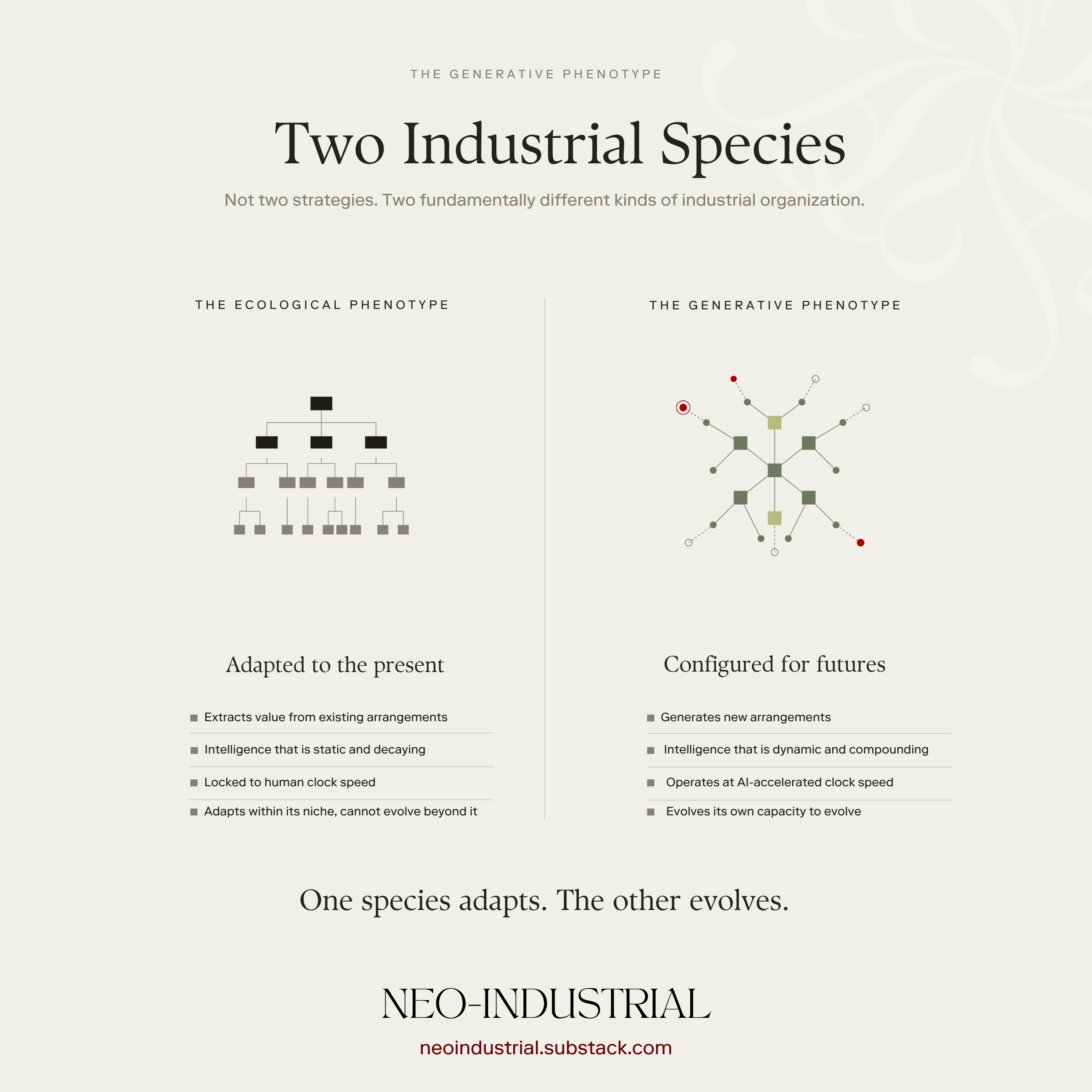
This is the ontological difference. The incumbent has intelligence (static, institutional, slowly decaying) and operates at human clockspeed. The Neo-Industrial Company generates intelligence (dynamic, compounding, continuously evolving) and operates at AI-accelerated clockspeed.
The Clockspeed Gap
The difference in clockspeed deserves attention because it is both a cause and a consequence of the phenotypic difference.
The incumbent’s clockspeed is constrained by its architecture. Information flows through established channels. Decisions require committee approval. Learning happens through quarterly reviews. Design cycles follow waterfall processes calibrated decades ago. The organization literally cannot think faster because its cognitive architecture, human-only, hierarchical, and procedural, imposes hard limits on processing speed.
The Neo-Industrial Company’s clockspeed is liberated by its architecture. The AI-powered DBTL cycle has been turbocharged: the Design and Learn phases accelerated by orders of magnitude through machine learning, the Build and Test phases compressed through Digital Original simulation and rapid prototyping. Information flows in real-time through integrated data systems, and learning compounds as every process run updates organizational intelligence.